You've planned the campaign, cleaned the copy, checked the subject line, and scheduled the send. Then the results arrive: engagement is weak, complaints are rising, and the customer database looks healthier than it behaves. A closer review reveals undeliverable addresses, dormant sign-ups, automated registrations, and customer records that no one has reassessed since onboarding.
That situation is more than an email-marketing problem. It's a customer risk problem. The same record can affect fraud exposure, churn forecasting, payment decisions, and the quality of every future customer interaction. A risk-scoring system makes those signals visible early enough for your team to act.
Table of Contents
- The Day a Customer List Quietly Became a Risk Problem
- What Customer Risk Scoring Actually Means
- The Signals That Feed a Risk Score
- Why Email Reputation Belongs in the Model
- Three Core Use Cases for Customer Risk Scoring
- Building the Pipeline and Integrating Verification
- Keeping a Risk Scoring System Honest Over Time
The Day a Customer List Quietly Became a Risk Problem
The marketing team had a reasonable explanation for the campaign underperformance. The audience was broader, the message was new, and the timing wasn't perfect. Yet the pattern didn't fit. A larger send reached fewer real people, deliverability complaints increased, and the churn dashboard began showing movement that the retention team couldn't explain.
Someone exported the customer list and compared recent registrations with campaign activity. The file contained addresses that could never receive mail, disposable inboxes created for one-time access, abandoned sign-ups, and profiles with inconsistent names, devices, and locations. None of those records had been marked as risky because the company treated email hygiene as a pre-send marketing task rather than as customer intelligence.
That distinction matters. An invalid address may indicate a simple typo. A disposable address may indicate a customer who wants privacy, or an account created to exploit an offer. A sudden address change followed by failed payments and declining engagement may point to churn. The email field doesn't prove intent, but it gives the model another way to evaluate what the customer record represents.
Practical rule: If a signal can change whether you accept, monitor, contact, or retain a customer, it belongs in the risk conversation.
The team eventually recognized that every unmeasured bad record created a small operational debt. It consumed campaign capacity, distorted engagement reporting, weakened confidence in churn forecasts, and made legitimate customers harder to identify. Customer risk stays invisible when teams inspect records only at isolated moments.
A useful scoring system turns that invisible exposure into a living view. It doesn't label every customer permanently. It records what the business knows now, watches for change, and routes different customers toward proportionate actions.
What Customer Risk Scoring Actually Means
Customer risk scoring is the practice of estimating how much risk a customer represents for a specific business decision. The risk might involve fraud, payment default, churn, regulatory exposure, or wasted outreach. The score helps a team decide what to do next, but it isn't a verdict about the customer.
The discipline grew from credit-risk practices. Fair Isaac had been developing scoring methods since 1956, sold its approach to lenders in 1958, and introduced a behavior-scoring system in 1975 to predict the risk of existing Wells Fargo customers, as described in this history of the credit score. In 1989, Fair Isaac launched the first general-purpose FICO score for consumer credit, helping lenders evaluate consumers consistently. Fannie Mae and Freddie Mac later began using FICO scores in 1995, establishing the model as a foundation for mortgage underwriting, according to the same source.
The inherited logic is straightforward. Gather relevant evidence, combine it consistently, and estimate the likelihood of an outcome. Modern customer-risk systems apply that logic to a wider signal surface, including identity, geography, product usage, transactions, devices, and communication behavior.
A score is a probability, not a permanent identity
A static label says, “This customer is high risk.” A serious system asks, “What evidence made the score rise, and is that evidence still present?” That difference affects both operations and fairness.
A customer who looked safe during onboarding may later show unusual transaction velocity, a new device pattern, or an address that fails verification. Another customer may become less risky after completing stronger identity checks and demonstrating consistent behavior. For that reason, enterprise case-management systems preserve score history, including timestamps and the algorithmic or rule-based values that produced each score. Oracle's documentation describes this history as a time series that lets analysts inspect how risk changes across a selected period and compare current values with earlier periods.
A practical model therefore needs:
- A defined outcome: Decide whether you're estimating fraud, default, churn, outreach waste, or another risk.
- A repeatable calculation: Use consistent features, rules, and thresholds rather than individual intuition.
- A history: Store prior scores, input values, timestamps, and important overrides.
- A feedback loop: Feed confirmed outcomes back into evaluation and model improvement.
The score only becomes useful when it changes decisions without hiding the reasoning behind them.
The Signals That Feed a Risk Score
A customer risk score usually combines several signal families, because no single feature captures the customer's full situation. Identity signals describe who the customer claims to be. Behavioral signals describe what the customer does. Geographic and device signals add context, while product and channel signals show how the relationship operates.
From raw events to model features
The raw data rarely enters the model unchanged. An email address might become a set of features describing validity, domain type, and prior delivery outcomes. A login stream might become indicators for velocity, session consistency, or unusual access patterns. A payment record might become a feature for failed attempts, payment-method changes, or transaction irregularity.
Models then combine those features through a method suited to the organization. A rules engine is transparent and easy to audit. A logistic-regression baseline can provide interpretable probabilities. Gradient-boosted models can detect more complex relationships, but they require stronger governance and explanation practices. The choice should reflect the decision's consequences, not a desire for technical complexity.
| Signal Family | Examples | Primary Risk It Captures |
|---|---|---|
| Identity | Email validity, phone match, document verification, ownership data | Impersonation, synthetic identity, onboarding uncertainty |
| Geography | IP location, stated address, high-risk region, location changes | Geographic exposure, inconsistency, cross-border risk |
| Device and access | Device consistency, proxy indicators, login patterns | Account takeover, automation, shared-account behavior |
| Behavior | Login cadence, transaction velocity, support interactions, product usage | Fraud, churn, abnormal activity |
| Transaction and payment | Payment failures, refunds, chargebacks, transaction sequence | Payment abuse, financial loss, default indicators |
| Email reputation | Bounce history, disposable status, role account, engagement quality | Outreach waste, fraud clues, deliverability exposure |
Customer-risk models commonly use identity, geography, product or service usage, and behavioral history to place customers into low, medium, or high tiers. Those tiers can determine whether the customer receives lighter due diligence, standard monitoring, or enhanced review, as explained in this customer risk scoring overview.
Email deserves its own family because it crosses several categories at once. Before treating it as a simple contact field, teams should understand how email bounce rate affects list quality. For businesses that accept online payments, chargebacks also deserve separate attention, and a resource on Disputely chargeback rate solution can help teams think through that risk path.
The model's final output should remain connected to the evidence. A marketer needs to know why a customer was excluded from outreach. A compliance analyst needs to understand why a case was escalated. A customer-support agent needs enough context to avoid treating a model label as proof of wrongdoing.
Why Email Reputation Belongs in the Model
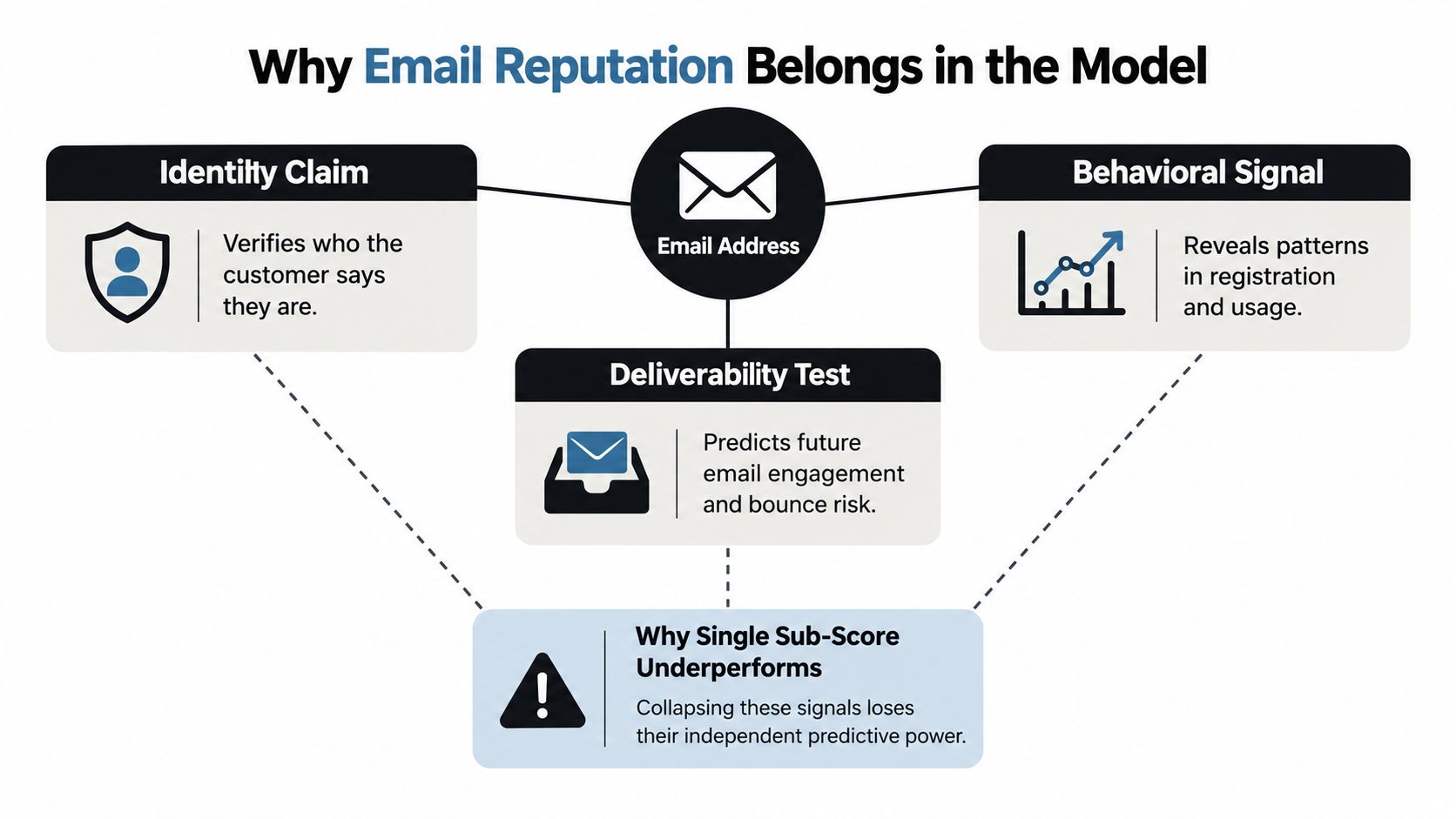
An email address performs three jobs at once. It's an identity claim, because the customer uses it to represent who they are. It's a deliverability test, because the address reveals whether future contact is likely to reach a functioning mailbox. It's also a behavioral signal, because registration patterns, address changes, and engagement can reveal how the account is being used.
Separate the evidence before combining it
A single email sub-score can hide important distinctions. Syntax and mailbox validity answer whether the address appears usable. A role-based address, such as a shared departmental inbox, may be deliverable but less useful for individual identity. A disposable domain may be valid today but unsuitable for a lasting customer relationship.
Other signals answer different questions:
- Address age: A newly created address can carry different uncertainty from a long-used address, especially during account creation.
- Bounce history: Repeated hard bounces indicate outreach risk and may also expose stale or fabricated customer data.
- Complaint history: Past spam complaints can affect the safety of future outreach.
- Engagement correlation: Opens alone can be ambiguous. Clicks, replies, product activity, and consistent interaction provide stronger context.
- Address changes: A sudden change combined with device, payment, or behavior anomalies deserves investigation rather than automatic rejection.
Those signals map to different business outcomes. A disposable address can increase uncertainty during promotional-account creation. A sudden address change followed by failed delivery can support a churn alert. A broad set of risky addresses can lower campaign quality for the rest of the list.
Put verification upstream
A bulk verification API can evaluate email evidence before the scoring engine assembles the customer profile. The pipeline can then pass structured fields such as validity, role status, disposable status, and reputation indicators into the same feature layer that receives device, transaction, and behavioral data.
That approach keeps email hygiene from becoming a last-minute cleanup exercise. Teams that want to understand the broader operating model can review this guide to email reputation services. The important design choice is separation: preserve the individual email findings, then let the customer-risk model decide how much each finding matters for the use case.
Three Core Use Cases for Customer Risk Scoring
The same customer record can need different scores for different decisions. A fraud model asks whether the next action looks dangerous. A churn model asks whether the relationship is weakening. An outreach model asks whether contacting the customer is worthwhile and safe for the sending channel.
| Use Case | Dominant Signals | Threshold Posture | Email Reputation Weight |
|---|---|---|---|
| Fraud prevention | Identity, device, geography, transaction velocity, account activity | Conservative, with decline and review paths | Heavy input when combined with other anomalies |
| Churn prediction | Product usage, engagement decay, support history, tenure, payment issues | Early-warning posture, with intervention before escalation | Moderate context for contactability and disengagement |
| Outreach prioritization | Engagement, purchase intent, customer value, channel response | Gating and prioritization rather than punitive rejection | Strong filter for deliverability and list quality |
Fraud prevention
Fraud scoring belongs close to the action. The model can combine email uncertainty with device inconsistency, unusual velocity, geographic mismatch, and payment anomalies. A risky email alone shouldn't decide the outcome, but several independent signals may justify a decline or manual review.
The threshold posture is deliberately cautious. A low-confidence identity should face stronger verification when the potential loss is material. Teams should document which combinations route a customer to acceptance, review, or decline.
Churn prediction
Churn scoring uses the score as an early-warning indicator, not a reason to block the customer. Declining product usage, unresolved support interactions, payment failures, and weaker engagement can suggest that the relationship is deteriorating.
Email reputation matters here because it tells the retention team whether email is a viable intervention channel. An address that bounces shouldn't receive a sequence designed to recover engagement. The team may need an in-product message, phone contact, or another approved channel instead.
Outreach prioritization
Outreach models use risk differently. The objective is to prioritize customers who are likely to respond while filtering addresses that could damage campaign performance or waste sales effort. An undeliverable or disposable address may be excluded from the send even when the customer record remains active for other business purposes.
Choose the primary use case first. If you blend fraud, churn, and outreach into one score, stakeholders may misread a model designed for one decision as an answer to another.
Building the Pipeline and Integrating Verification
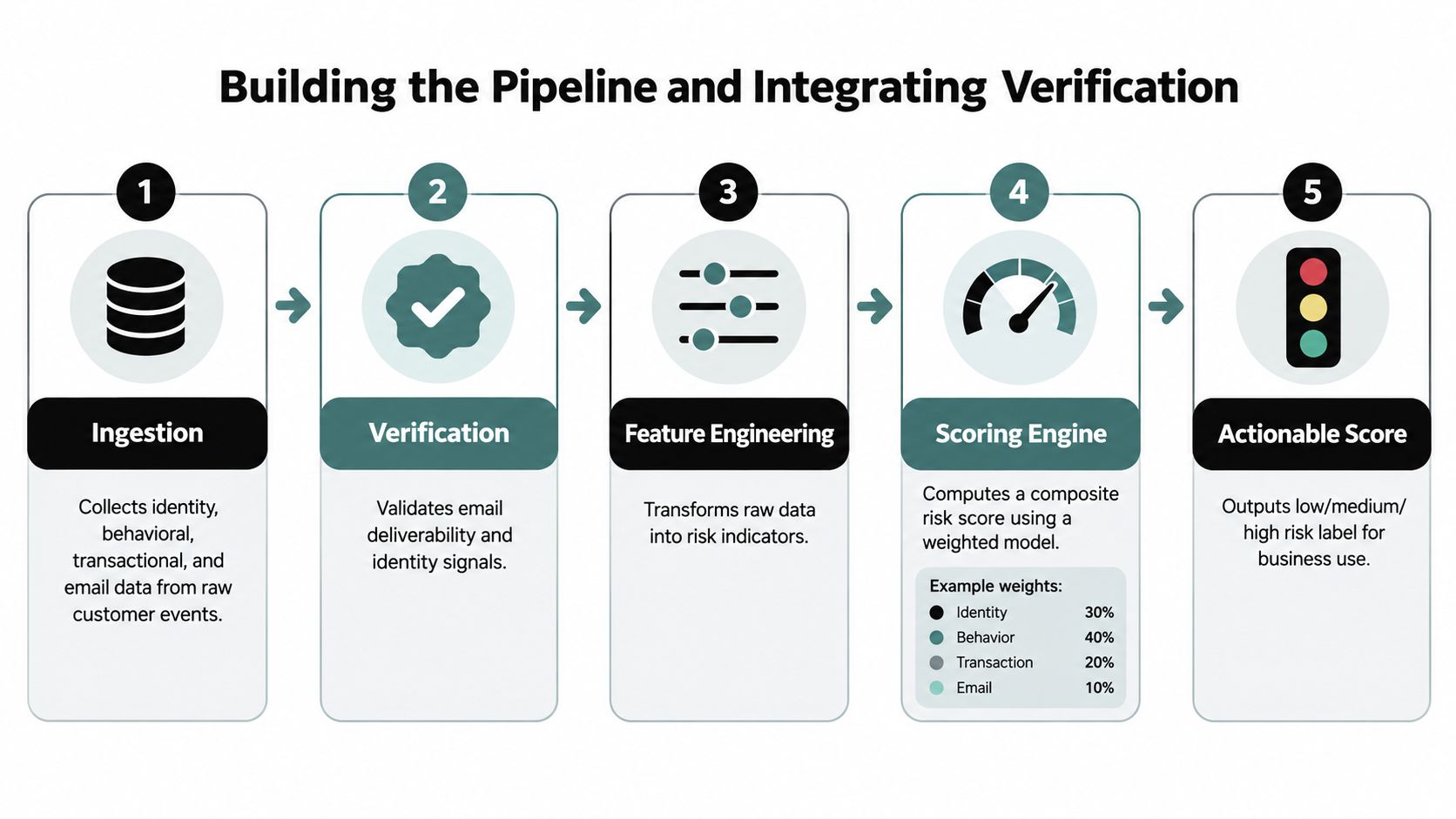
A production pipeline starts with events, not labels. Registration, login, transaction, support, payment, device, geographic, and email events enter a central data layer. The system then verifies and enriches those events before assembling features for the scoring engine.
A practical sequence
- Ingest the event: Capture the customer action, timestamp, account identifier, channel, and relevant context.
- Verify the email: Check whether the address is valid, deliverable, role-based, disposable, or associated with concerning history.
- Assemble features: Convert raw observations into consistent indicators, preserving the source and time of each value.
- Calculate the score: Apply a rules engine, statistical model, machine-learning model, or managed scoring service.
- Route the result: Send the customer to an accept, review, monitor, decline, or outreach-suppression path.
CleanMyList can sit at the verification stage, where each new or reactivated address receives structured verdicts before the record reaches the scoring layer. Its checks cover syntax, DNS, SMTP mailbox existence, catch-all behavior, disposable providers, role accounts, historical bounce reputation, and a send-or-skip recommendation. Teams can upload a CSV, paste addresses, receive results, export a cleaned list, or connect verification to signup through a widget or API. The service says it doesn't send email during verification, encrypts data, and deletes lists after 30 days. More implementation detail is available in this guide to an email verification API.
Select the simplest model that fits
A rules engine works well when your team needs immediate explanations and has a clear policy. Logistic regression offers a transparent baseline and can help analysts understand feature direction. Gradient-boosted models may capture nonlinear relationships, but they need stronger monitoring, documentation, and explanation. A managed API can reduce engineering effort while limiting control over the underlying model.
Set routing thresholds with the business owner and risk owner together. Then record every override and eventual outcome. Confirmed fraud, successful reviews, later churn, and valid customers who were incorrectly suppressed all become feedback for model evaluation.
For teams evaluating referral abuse, a focused resource on protecting Square merchants from referral fraud provides useful context on how fraud controls can sit around a merchant workflow rather than inside marketing alone.
A first deployment checklist should include:
- Define the decision: Name the action the score controls.
- Inventory the signals: Record source, owner, freshness, and known limitations.
- Verify before scoring: Keep email evidence separate from the composite result.
- Create review queues: Give analysts a documented path for uncertain cases.
- Store history: Retain scores, features, timestamps, and overrides.
- Measure outcomes: Compare predictions with confirmed results and customer impact.
Keeping a Risk Scoring System Honest Over Time
A model can be technically sound at launch and still become unreliable. Fraud patterns change, customer behavior shifts, acquisition channels evolve, and a signal that once indicated risk may later reflect a legitimate change in the customer base.
The maintenance program needs three connected disciplines: cadence, explainability, and fairness. Cadence catches performance and data drift. Explainability lets people challenge or defend a decision. Fairness reviews identify cases where a seemingly neutral feature acts as a proxy for protected characteristics.
Put reviews on the calendar
Review current scores against prior periods and inspect the outcomes attached to each tier. Look for rising review volumes, unexpected declines in valid customers, new clusters of false positives, and email signals that no longer behave as expected.
Dynamic systems are designed to recalculate as new signals arrive. Real-time scoring may incorporate transaction velocity, geolocation consistency, device intelligence, and historical behavior at decision time, allowing an immediate response to patterns such as rapid activity across regions or device anomalies. The case for this approach is discussed in research on real-time risk scoring and decision systems.
Review question: Did the score change because the customer changed, because the data changed, or because the model changed?
Explain every material decision
A customer-facing team doesn't need the entire model architecture. It does need a clear rationale, such as “mailbox could not be verified,” “device pattern changed,” or “transaction activity exceeded the customer's prior pattern.” Weighted scorecards can make that rationale direct. SHAP and LIME can help explain more complex models, particularly when compliance teams need to inspect the contribution of individual features.
The model should also distinguish evidence from conclusion. “Disposable domain detected” is an observation. “Fraud confirmed” is a conclusion that requires additional evidence.
Test fairness and drift
Email domain, geography, language, device type, and purchasing behavior can correlate with legitimate demographic or regional differences. Review whether thresholds create unequal outcomes, and document why each signal is relevant to the decision. Academic discussion of explainability in credit-risk scoring has increasingly focused on frameworks such as SHAP and LIME because auditable AI matters alongside predictive performance, as discussed in this OECD consumer finance risk monitor.
Recent guidance also treats risk as dynamic, using geography, sector, transaction behavior, ownership structure, PEP and sanctions exposure, and adverse media. Operational teams should therefore define event triggers, review ownership, and override rules rather than relying on an onboarding label. The commercial pressure is real too. A 2026 European KYB survey reported that 81% of firms lost prospective clients because onboarding was too slow, according to SmartSearch's 2026 risk-scoring guidance. That makes responsive scoring a growth concern as well as a control concern.
Finally, document the review. Keep a record of threshold changes, drift findings, fairness tests, explanations, overrides, and actions taken. A risk system earns trust when people can reconstruct not only what it decided, but why it decided it and how the organization responded.
CleanMyList helps teams verify new, reactivated, and existing email addresses before those records influence customer-risk decisions or enter a campaign. Upload a list or connect validation at signup, review plain-English verdicts across multiple email signals, and visit CleanMyList to start with the available free credits.