You export a CSV that hasn't been touched since last spring, load it into your email tool, and hit send on the biggest campaign of the quarter. Within an hour the bounce count is climbing, your open rate looks broken, and by the next morning a chunk of your Gmail traffic is landing in spam. The copy didn't cause that. The list did.
Email databases get dirty the way a house gets dirty: a little every day, invisibly, until one afternoon you notice the film on everything. Addresses die when people change jobs. Typos slip through signup forms. Disposable domains and role accounts pile up after a giveaway or a purchased import. None of it announces itself.
The fix isn't a heroic weekend purge. It's a short, repeatable routine, the same principle behind a recurring housekeeping scope for busy families: a fixed set of chores, done in order, often enough that the deep clean never becomes necessary.
So here's a basic cleaning list you already know by heart, mapped onto your email list. Dusting is your syntax and typo pass. Vacuuming is bulk verification. Mopping handles the sticky residue left behind. Disinfecting is risk control. The bathroom is decay. Dishes are daily ownership. Trash is suppression. Laundry is sorting. Eight chores, eight list-cleaning steps, one routine you can keep.
Table of Contents
- 1. Dusting
- 2. Vacuuming and Sweeping Floors
- 3. Mopping Hard Floors
- 4. Disinfecting Kitchen Counters and High-Touch Surfaces
- 5. Cleaning the Bathroom
- 6. Washing Dishes
- 7. Emptying Trash and Recycling
- 8. Doing Laundry
- How the eight basic cleaning tasks compare at a glance
- Turn Your Basic Cleaning List Into a Repeatable Email Routine
1. Dusting
A hand wiping down shelves in a bookcase, working downward, is the whole technique in one frame.
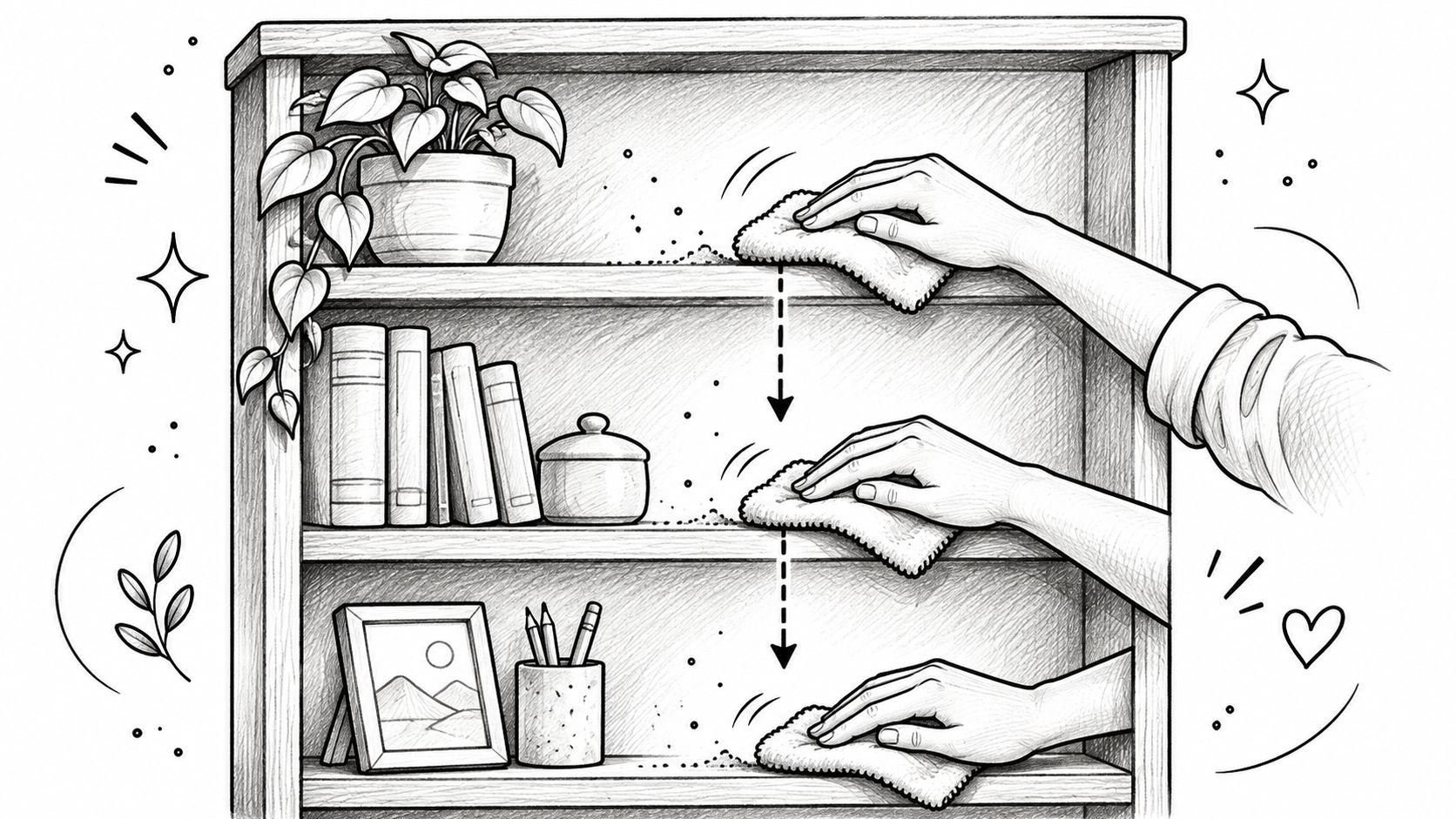
Dusting removes loose particles before they get ground into anything. Use a slightly damp microfiber cloth, not a feather duster, which mostly relocates dust into the air you're about to breathe. Work top to bottom, ceiling fan blades and light fixtures first, shelves and baseboards last, and dust before you vacuum so the floor pass collects what fell.
Your list has the same loose layer: malformed addresses, obvious typos, and duplicates. This is the cheapest pass you'll ever run, and skipping it is expensive. GetResponse's email marketing benchmarks put the average bounce rate at 2.33%, which on a 100,000-address send means roughly 2,330 bounced messages before anyone even reads your subject line.
Stop the dust at the source
If a room re-dusts itself within a day, the problem is upstream in the ductwork, which is the argument behind duct cleaning advice for Phoenix homeowners. Signup forms are your ductwork. A one-line validation widget that blocks typos and fakes at the point of entry keeps the mess out of the database entirely.
Practical rule: every address you prevent at signup is one you never pay to verify, one you never bounce on, and one that never skews your segment reporting.
Say a publisher runs a quiz giveaway and pulls in thousands of entries in a weekend. A syntax and typo pass catches gmial.com and yhaoo.com before the welcome series fires. That's dusting: unglamorous, fast, and it makes every later step easier.
2. Vacuuming and Sweeping Floors
Suction does what a broom can't. Sweeping moves debris into piles; a vacuum with decent filtration lifts embedded grit out of carpet fibers, which is where the damage happens. Grit left in a carpet cuts the fibers every time someone walks over it.
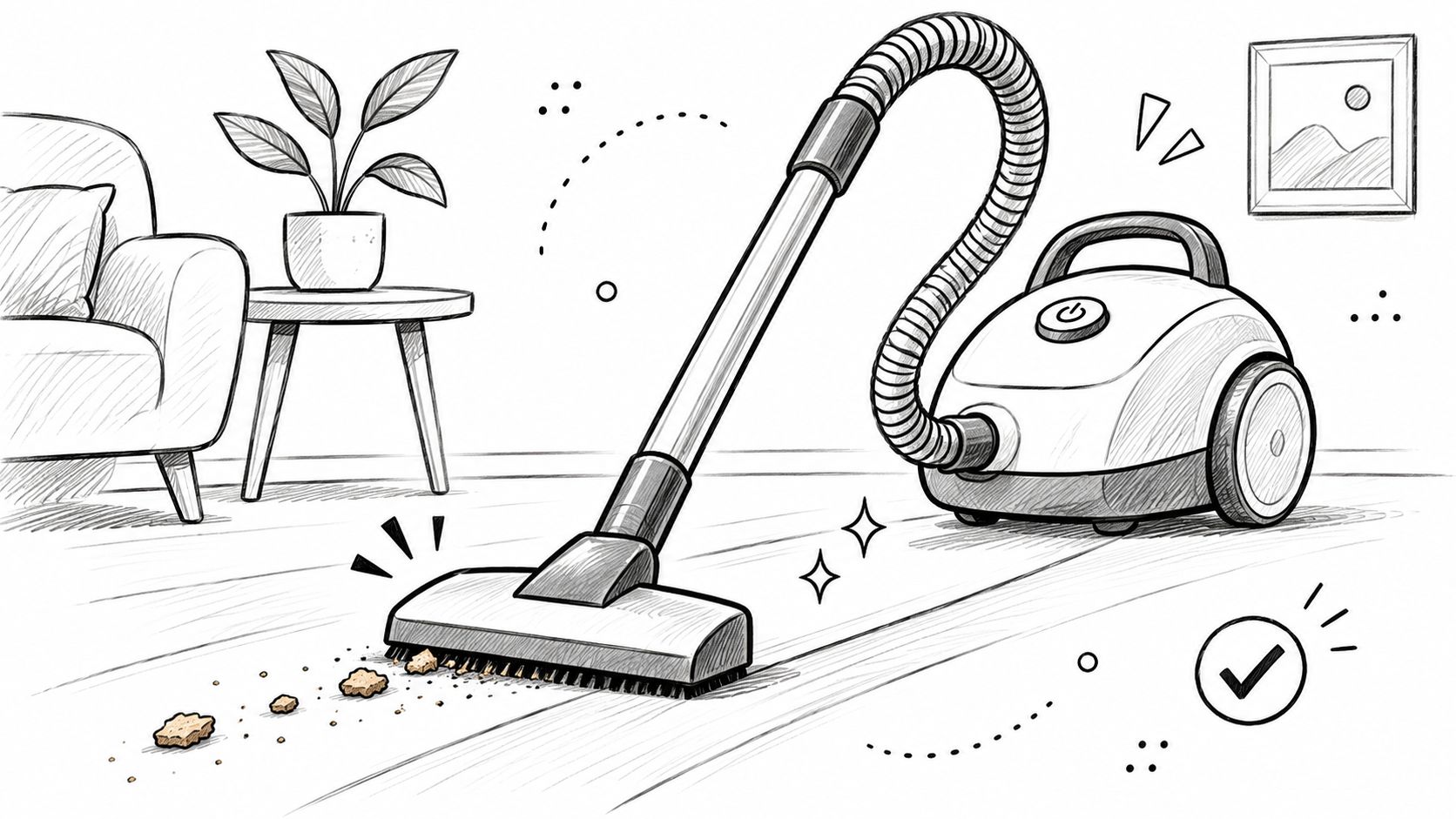
Bulk verification is your vacuum. It reaches the addresses that look fine on the surface but don't exist: dead mailboxes, parked domains, accounts disabled months ago. Run overlapping rows, meaning check the whole file, not just the segment you're mailing this week. And empty the canister, meaning export and act on the results instead of leaving a verification report unread in a folder.
What a clean pass should produce
Sinch Mailgun's 2025 email impact analysis covered more than 400 billion emails and found most leading industries stayed well under 0.5% bounce, with the lowest observed industry rate at 0.01%. That's the number to judge your cleaning against, not a vendor's promise of a "clean list."
- Measure removals by category: syntax failure, nonexistent domain, mailbox failure, catch-all, disposable, role account, duplicate.
- Compare before and after: run equal audience segments, one cleaned and one not, on comparable campaigns.
- Distrust a clean that changes nothing: if you removed thousands of records and bounces stayed flat, your problem is consent, traps, or infrastructure, not validity.
A robot vacuum works because it runs daily without anyone deciding to run it. Automate the same way: verify on import, not on the morning of the launch.
3. Mopping Hard Floors
Mopping is where people get overconfident. Sweeping picked up the crumbs, so the floor looks done, but the sticky film is still there and it will grab every new speck of dirt that lands.
The email equivalent is the residue that survives a syntax and mailbox pass: catch-all domains that accept everything at SMTP level and tell you nothing, soft bounces from full mailboxes or greylisting, and addresses at providers that throttle verification probes into useless answers. A damp mop, not a soaking one, is the right mental model. Too much water swells laminate seams and ruins the floor you were trying to protect.
Handle uncertainty without deleting it
Over-aggressive verification is the soaked mop of list hygiene. Blanket-deleting every catch-all address strips out a large share of legitimate B2B contacts, because plenty of company mail servers are configured to accept all recipients. I'd rather quarantine than delete.
Uncertain isn't the same as invalid. Tag catch-all records, mail them in small controlled batches, and let real engagement data decide.
Practical sequence, same as mopping from the far corner toward the exit:
- Separate the buckets. Valid, invalid, catch-all, disposable, role, unknown. Never merge unknown into invalid by default.
- Test the risky bucket slowly. Small sends, one domain at a time, watching hard bounces per domain rather than the account average.
- Check the floor material first. Laminate and sealed wood have different tolerances, and so do Gmail, Outlook, and a corporate Exchange server. Read the manufacturer's guidance before you apply water; read the provider's postmaster guidance before you apply volume.
Say an outbound team buys a list of agency contacts. Half the domains are catch-all. Mopping properly means keeping those addresses in a separate, slowly warmed sequence instead of either blasting them or binning them.
4. Disinfecting Kitchen Counters and High-Touch Surfaces
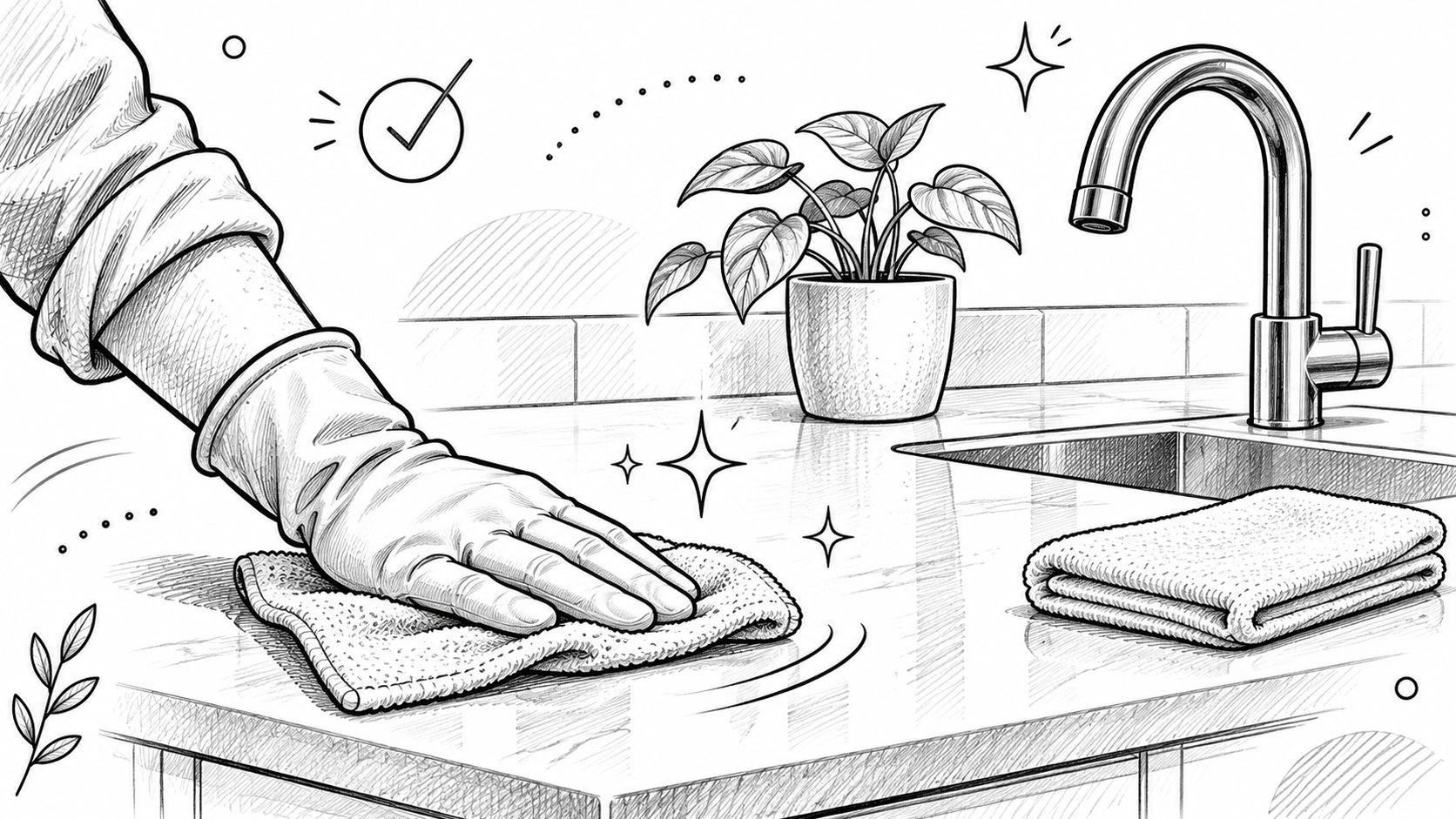
Cleaning and disinfecting aren't the same job. Cleaning removes soil. Disinfecting inactivates pathogens, and it only works if the surface stays visibly wet for the contact time printed on the label. Wipe a disinfectant straight off and you've done nothing except move residue around.
There's a harder lesson here about aggression. A 2025 report on the HOMEChem project, covered by the European Cleaning Journal, found that mopping with vinegar and spraying ammonia-based cleaners raised indoor ammonia concentrations to about 1,592 parts per billion, roughly 50 times baseline. The more thorough-feeling routine made the air worse.
Never mix products
Bleach plus ammonia produces toxic gas. In list terms, the dangerous mix is combining a scraped or purchased file with your consented subscriber base in one send. The purchased portion generates complaints and trap hits, and the reputation damage lands on the whole domain, including the people who asked to hear from you.
- Clean first, then disinfect: remove invalids before you apply engagement-based pruning, or you'll cut good contacts for never opening mail that never arrived.
- Respect contact time: a suppression rule needs a few sends of evidence, not one bad Tuesday.
- Ventilate: if a segment keeps producing complaints, stop mailing it and investigate the acquisition source rather than increasing frequency to "re-engage" it.
High-touch surfaces are your highest-risk addresses: role accounts like info@ and sales@, disposable providers, and anything from a source you can't document. Disinfect those deliberately, keep them out of your main sends, and don't confuse a strong-smelling purge with a healthy list.
5. Cleaning the Bathroom
Bathrooms are the room that punishes inconsistency. Skip a week and soap scum hardens into something that needs acid and elbow work instead of a wipe. The grime didn't arrive suddenly; it accumulated while the room looked fine.
A walkthrough of the top-to-bottom order shows why sequence matters more than effort.
Decay is the soap scum of email
ZeroBounce's email list decay report found list decay ranged from 22% to 28% over the preceding five years, based on more than 11 billion email addresses verified during 2025. On an originally valid list of 100,000, even the low end means roughly 22,000 addresses drifting out of usability. People change jobs, abandon inboxes, switch providers, and companies retire domains.
That's why "we cleaned it at import" isn't a defense. A clean list is a temporary state, like a clean shower.
The routine that keeps it from hardening:
- Mirrors and fixtures first: re-verify your highest-value segments, active customers and recent signups, before every major send.
- Tub and toilet next: aged segments that haven't been mailed in months get a full re-check, not a spot clean.
- Floor last: the long-dormant tail gets verified or retired, and you stop paying to store it.
- Separate cloth for the toilet: keep your re-engagement experiments isolated from your main sending domain so a bad batch can't contaminate the rest.
Let the cleaner sit on soap scum for a few minutes before scrubbing. Same with a stale segment: give it a proper re-verification pass before you decide it's dead, because plenty of those addresses are still perfectly deliverable and haven't been mailed.
6. Washing Dishes
Dishes are the chore that never ends, which makes them the honest model for list maintenance. Nobody "finishes" dishes. You do them after every meal or you wake up to a sink that attracts pests.
Hand washing works if you sequence it: glassware first in clean water, then plates, then greasy pans. A dishwasher works if you load it properly and don't block the spray arm. Both fail when someone else assumes someone else is doing it.
The ownership problem is real
Deloitte's 2025 Women at Work survey of 7,500 women across 15 countries found 57% of partnered women said they held the greatest responsibility for cleaning, compared with 8% who said it fell primarily to their partner or spouse. A checklist isn't neutral. It assigns work to whoever notices the mess first.
The same thing happens in marketing teams. One person becomes the unofficial list janitor, and the moment they're on leave, nobody verifies anything.
Write the ownership down instead:
- Acquisition owner: whoever runs the form, ad, or import verifies at the point of entry, every time.
- Campaign owner: whoever schedules the send re-checks the segment before it goes out.
- Ops owner: one named person maintains the suppression list and reviews bounce reports weekly.
Commercial kitchens use a three-compartment sink: wash, rinse, sanitize. Three named stages, no ambiguity about which one you're standing at. Give your list workflow the same clarity, and air-dry the results on a rack, meaning publish the cleaned file where the whole team can see it rather than leaving it wet in one person's downloads folder.
7. Emptying Trash and Recycling
Trash is a timing task. Wait until it smells and you've already lost. The bin doesn't get less unpleasant while you decide whether tonight's the night.
Hard bounces are trash, and they need to leave the building permanently. A hard bounce is a permanent failure signal: the mailbox doesn't exist and won't exist next week either. Re-importing those addresses in your next "full database" export is the equivalent of putting the bag back in the kitchen.
Suppression is the bin liner
Cloudflare's deliverability guidance recommends keeping hard-bounce rates below 2% and overall delivery rates above 95%, treating hard bounces as permanent suppression events and investigating soft bounces separately. It also pairs hygiene with gradual volume increases, consistent sender identity, and mailing only people who expect the message.
- Hard bounce: suppress immediately and permanently, across every list and every tool.
- Soft bounce: count occurrences by domain before acting, since a full mailbox or a temporary deferral isn't a dead address.
- Complaint: suppress harder than a bounce, and go find the acquisition source that produced it.
- Unsubscribe: honor it everywhere, not just in the one campaign's audience.
Recycling has a contamination rule too. Sorting facilities reject loads with the wrong material in them, which is why cities publish color-coded bin guides. Your recycling bin is the re-engagement queue: addresses that went quiet but are still valid and still consented. Keep them separate from the trash, and never let a suppression file get merged back into a "win-back" segment because someone forgot to filter it.
Rinse the container before it goes in the bin, and wipe the bin itself occasionally. In practice: audit your suppression list quarterly for entries added by mistake, and check that every tool you send from has the current version.
8. Doing Laundry
Sorting is the entire skill. You don't wash everything on one cycle at one temperature, because a red sock in a white load ruins garments that were perfectly fine before you started. Read the care label, match the cycle, and use the detergent dose your water hardness and load size call for. More detergent doesn't mean cleaner clothes; it means residue.
Sort by source, not just by validity
Two addresses can both be valid and belong in completely different loads. Sort your database by:
- Acquisition source: organic signup, checkout, giveaway, partner import, outbound prospecting. Each carries different consent and different risk.
- Engagement recency: recent openers, lapsed, never-engaged. These get different frequencies and different sending domains.
- Domain: Gmail, Outlook, Yahoo, and corporate domains behave differently and deserve separate reputation tracking.
- Verification verdict: valid, catch-all, disposable, role, unknown, invalid.
Say a DTC brand mails its whole file on Black Friday, mixing three years of checkout addresses with a giveaway list from a partner. The giveaway load bleeds dye across everything, and the customers who buy get worse inbox placement as a result.
Wash the machine too. Front-loaders grow mold in the gasket if you never clean it, and your email tool accumulates the same residue: obsolete automations pointing at dead segments, saved filters nobody remembers creating, tags applied by a form you deleted two years ago. Clean the drum before you blame the detergent.
How the eight basic cleaning tasks compare at a glance
| Item | Main Target | Primary Tools | Common Pitfall |
|---|---|---|---|
| Dusting | Dust, pollen, and debris on surfaces | Microfiber cloth | Dry dusting can spread particles |
| Vacuuming and Sweeping Floors | Dirt, hair, crumbs, and grit on floors | Vacuum, broom, or sweeper | Clogged filters or missed floor areas |
| Mopping Hard Floors | Sticky residue and grime on hard floors | Mop and floor-appropriate cleaner | Excess water can damage floors |
| Disinfecting Kitchen Counters and High-Touch Surfaces | Germs on counters, handles, and other touchpoints | Cleaner and disinfectant | Not allowing enough contact time |
| Cleaning the Bathroom | Soap scum, deposits, mold, and residue | Bathroom cleaner, brushes, and sponges | Poor ventilation or skipped grout and corners |
| Washing Dishes | Food residue, grease, and germs on dishes | Dish soap, sponge or brush, dishwasher | Improper loading or unsanitized sponges |
| Emptying Trash and Recycling | Household waste and recyclables | Bins and correctly sized bags | Contaminating recyclables with food residue |
| Doing Laundry | Dirt, sweat, oils, and stains on fabrics | Washing machine and detergent | Overloading or sorting clothes incorrectly |
Turn Your Basic Cleaning List Into a Repeatable Email Routine
A cleaning routine only counts if it's on the calendar. Put list hygiene in the same recurring slot as your reporting: a quick verification pass before every major send, a full re-check of any segment you haven't mailed in a quarter, and a monthly review of bounces broken out by domain and acquisition source rather than one account-wide average that hides everything.
Tag rather than delete wherever you're uncertain. Invalid addresses come out and go straight into suppression. Stale addresses get re-verified before you retire them. Disposable and role accounts get flagged and kept out of your main sends. Catch-all records stay quarantined for controlled testing. Every category gets a decision, and the decision gets written down so the next person doesn't relitigate it.
Keep the report. Every cleaning run should leave you with a downloadable record of what was removed, in which category, and why, so you can compare the cleaned segment's bounce rate against the uncleaned baseline. That before-and-after comparison is the only honest way to know whether your cleaning rules are working or just deleting revenue.
The last mile is getting the clean file back into the tool you send from. A clean list can be downloaded or pushed straight back into your email tool, with bad addresses tagged so they stay out of your next send. CleanMyList connects with Mailchimp, Brevo, Klaviyo, ActiveCampaign, MailerLite, GetResponse, beehiiv and others, so contacts can come in, get cleaned, and go back without a CSV round trip. Your original list stays untouched, which matters when you need to audit what changed.
Speed removes the usual excuse. A list of 10,000 emails takes around a minute to clean, and 100,000 takes about six minutes, so "we didn't have time before launch" stops being a real constraint. The whole job, messy list to clean list, is three steps: drop the list in, watch it clean, then send to real people.
Start with the file you're most nervous about. Run it once, read the report by category, and you'll know within minutes whether your next campaign is going to reach inboxes or bounce into a reputation hole you'll spend a month climbing out of.
CleanMyList checks every address across eight signals, syntax, DNS, SMTP mailbox existence, catch-all behavior, disposable providers, role accounts, historical bounce reputation, and a final send/skip recommendation, with a plain-English reason for each verdict and a downloadable report of what got cleaned. There's no subscription, credits never expire, and every account starts with 50 free credits with no card required. Take the list you've been putting off and run it through CleanMyList before your next send.