
Your signup form accepts jsmith@gmial.com. The user never receives a confirmation message, and your support team gets a complaint about a broken registration flow. Meanwhile, the marketing team imports an older contact list, launches a campaign, and discovers bad addresses through bounce notifications instead of catching them before sending.
A basic email validation library can accept that mistyped address because it has a plausible local part, an @, and a domain-shaped ending. Most local validators answer a narrow question: does this string satisfy the configured syntax rules? They don't establish that the domain receives mail, that the mailbox exists, or that the recipient wants your campaign.
Choose the verification layer before choosing the package:
- Syntax: Parse the address and reject malformed input.
- Domain: Check DNS and mail-routing signals.
- Mailbox acceptance: Assess whether the receiving server appears willing to accept the address.
- List-level risk: Combine verification with catch-all flags, suppression history, consent, and engagement.
Treat these as separate application decisions, not interchangeable definitions of valid. Just as you'd test expired promo code flows, test email failures deliberately, including mistyped domains, network timeouts, and inconclusive results.
The options below range from local parsers to hosted verification services. The right choice depends on where your current checks stop.
Table of Contents
- 1. validator.js
- 2. @haraka/email-address
- 3. isemail
- 4. Apache Commons Validator
- 5. Django EmailValidator
- 6. node-email-verifier
- 7. Abstract Email Validation API
- 8. ZeroBounce
- 9. Emailable
- What each email validation library checks, and what it costs to use
- Choosing the Right Layer Before You Choose a Package
1. validator.js
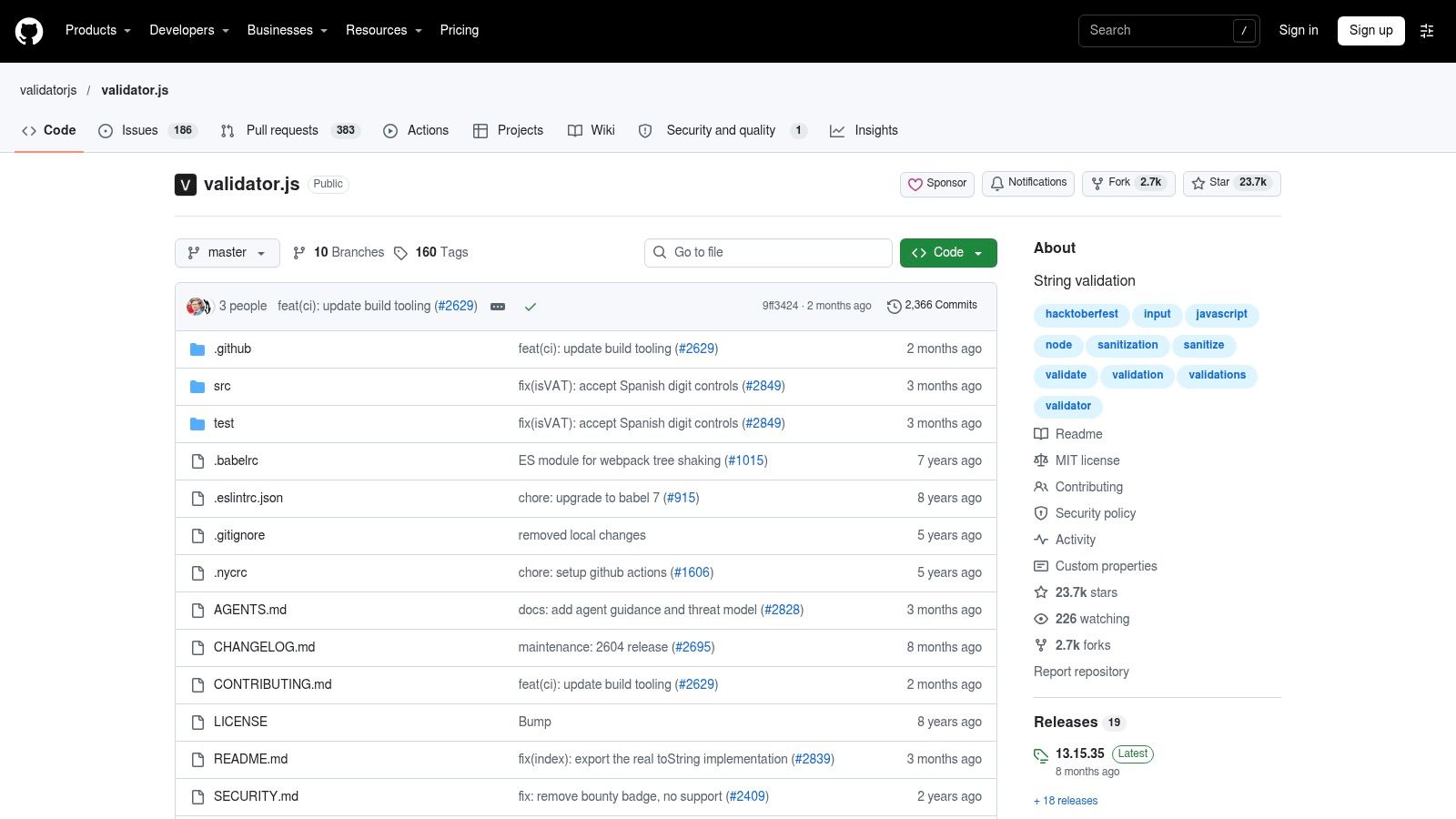
Verification ladder: syntax. validator.js is a practical choice when a JavaScript application needs email validation alongside other string validators. Its isEmail function runs locally, so a format check doesn't require a network request or an external account.
The useful feature isn't merely having an email check. It's being able to choose how that check treats UTF-8 local parts, display names, top-level domains, IP domains, and host allowlists or blocklists. Those settings let you define what your application accepts rather than hide that decision inside a homemade regular expression.
Make the Configuration Part of Your Contract
A registration field and an email-header importer shouldn't automatically share the same settings. A display name may belong in a header, while your signup database expects only the mailbox address.
- Best fit: JavaScript or TypeScript applications already using a broader input-validation toolkit.
- Main advantage: Configurable, local checks without introducing a verification-service dependency.
- Hard limit: A passing result doesn't prove that a domain receives mail or that a mailbox exists.
Keep frontend and backend settings aligned, but enforce the decision on the backend. Otherwise, a user can submit an address through an API that your browser form would've rejected.
Our guide to JavaScript email validation covers that implementation boundary. I'd choose validator.js for form hygiene, then add domain or mailbox checks only where the business decision requires them. It isn't a bulk list-cleaning workflow, and wrapping isEmail in a CSV loop doesn't make it one.
2. @haraka/email-address
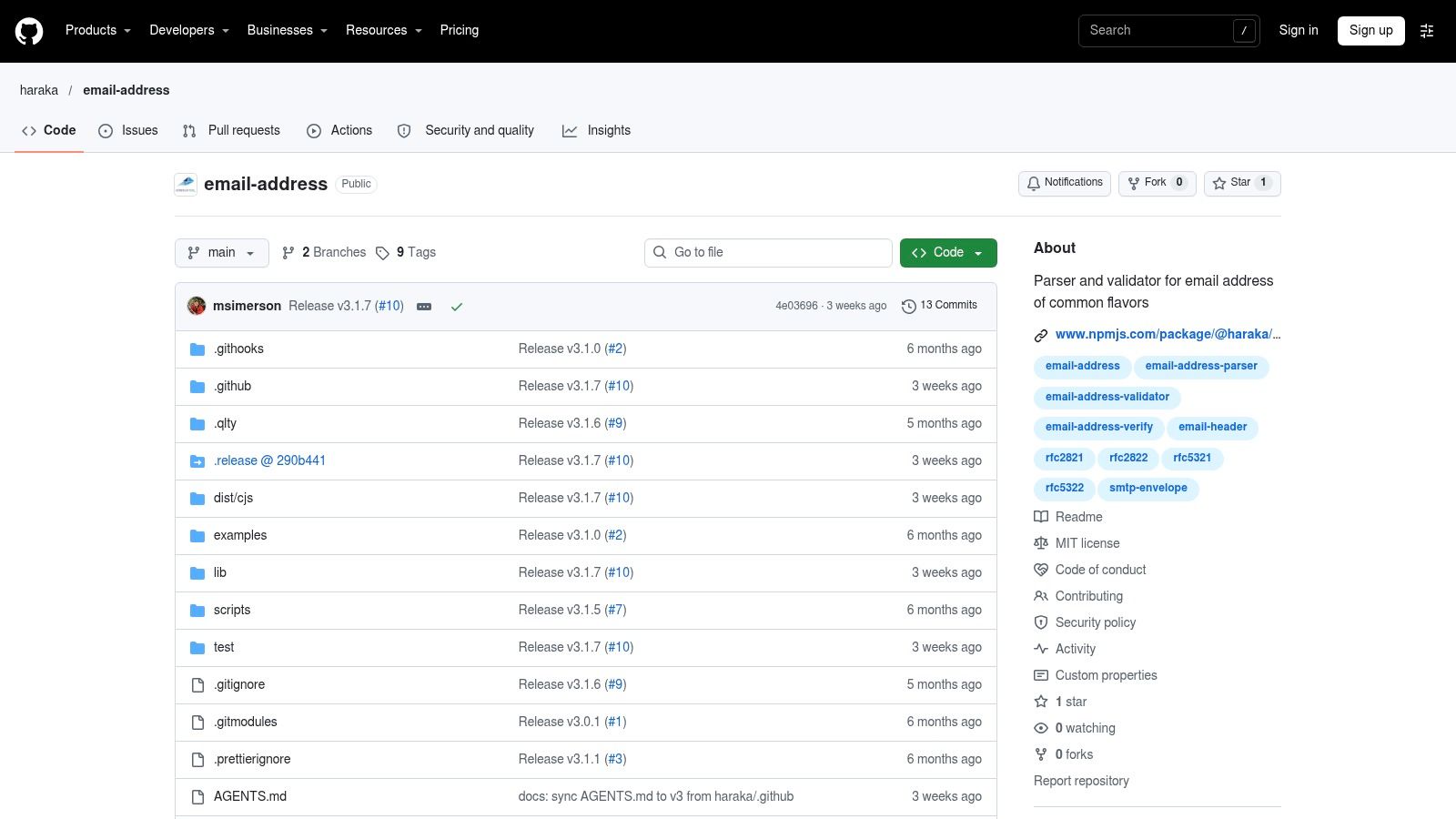
An incoming mail header isn't the same input as a signup field. It can contain display names, comments, quoted local parts, or address groups, so treating the whole value as a plain mailbox string creates avoidable parsing errors.
Verification ladder: syntax and structured parsing. @haraka/email-address distinguishes plain addresses, SMTP envelope addresses, and email-header syntax. That makes it more relevant to mail-handling software than to an ordinary newsletter form.
Choose the parser for the input you're receiving. Don't select the most permissive behavior just to make troublesome examples pass, because accepting header syntax in a mailbox-only field can leave downstream systems with a value they don't know how to use.
Practical rule: Parse rich address input into structured fields. Don't store a display name and mailbox together when your sending integration expects only the mailbox.
The package supports specialized syntax handling, including quoted local parts, comments, groups, and internationalized domains. Its project describes a zero-dependency implementation, which is useful when you're keeping the dependency surface of mail-processing software small.
Where the Extra Parsing Pays Off
Use it when importing headers, processing mail, or converting address-bearing input into structured records. Preserve the original input separately so you can diagnose parsing disagreements without reconstructing what the user supplied.
For a simple signup form, that specialization may be unnecessary. Correct parsing still stops at syntax: neither a successfully parsed header nor a well-formed envelope address establishes an active inbox, consent, or likely campaign delivery.
3. isemail
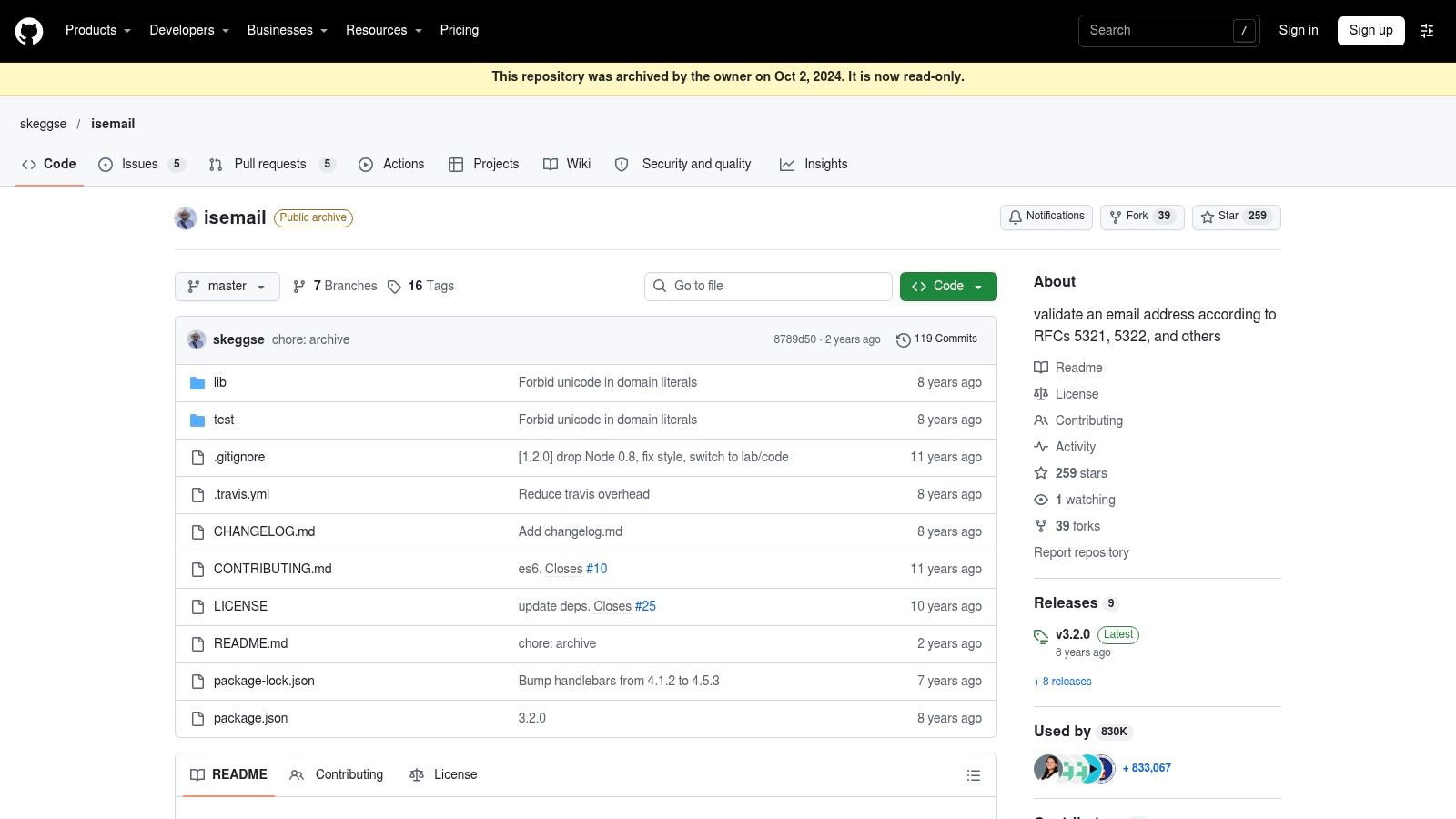
Verification ladder: address validation, not mailbox verification. isemail offers a dedicated Node.js validate(email, options) interface. It's worth considering when you want an email-focused dependency rather than a general string-validation toolkit.
The engineering advantage is a deliberate validation policy without maintaining your own increasingly complicated regular expression. You still need to decide which options match your application and document what a successful result means.
Test Acceptance Rules Before Adoption
Don't choose an email validation library solely because it accepts familiar examples. Your regression corpus should include legitimate unusual addresses as well as malformed input, because rejecting a real customer is also a validation failure.
- Include genuine edge cases: Test plus addressing, internationalized input, quoted forms where relevant, and accidental surrounding whitespace.
- Separate policy from syntax: A shared mailbox or disposable address might violate your signup policy without being malformed.
- Review project health: Inspect maintenance activity, supported runtimes, dependencies, and tests before adding the package to a backend.
Independent email-validation comparison coverage documents differences in false positives and false negatives across implementations. That makes a representative test corpus more useful than assuming every package interprets validity identically.
isemail doesn't clean campaign lists or establish mailbox ownership. If your requirement is to validate backend input, its focused interface may fit; if your requirement is to decide whether an aged contact should receive a campaign, you'll need additional signals and a different workflow.
4. Apache Commons Validator
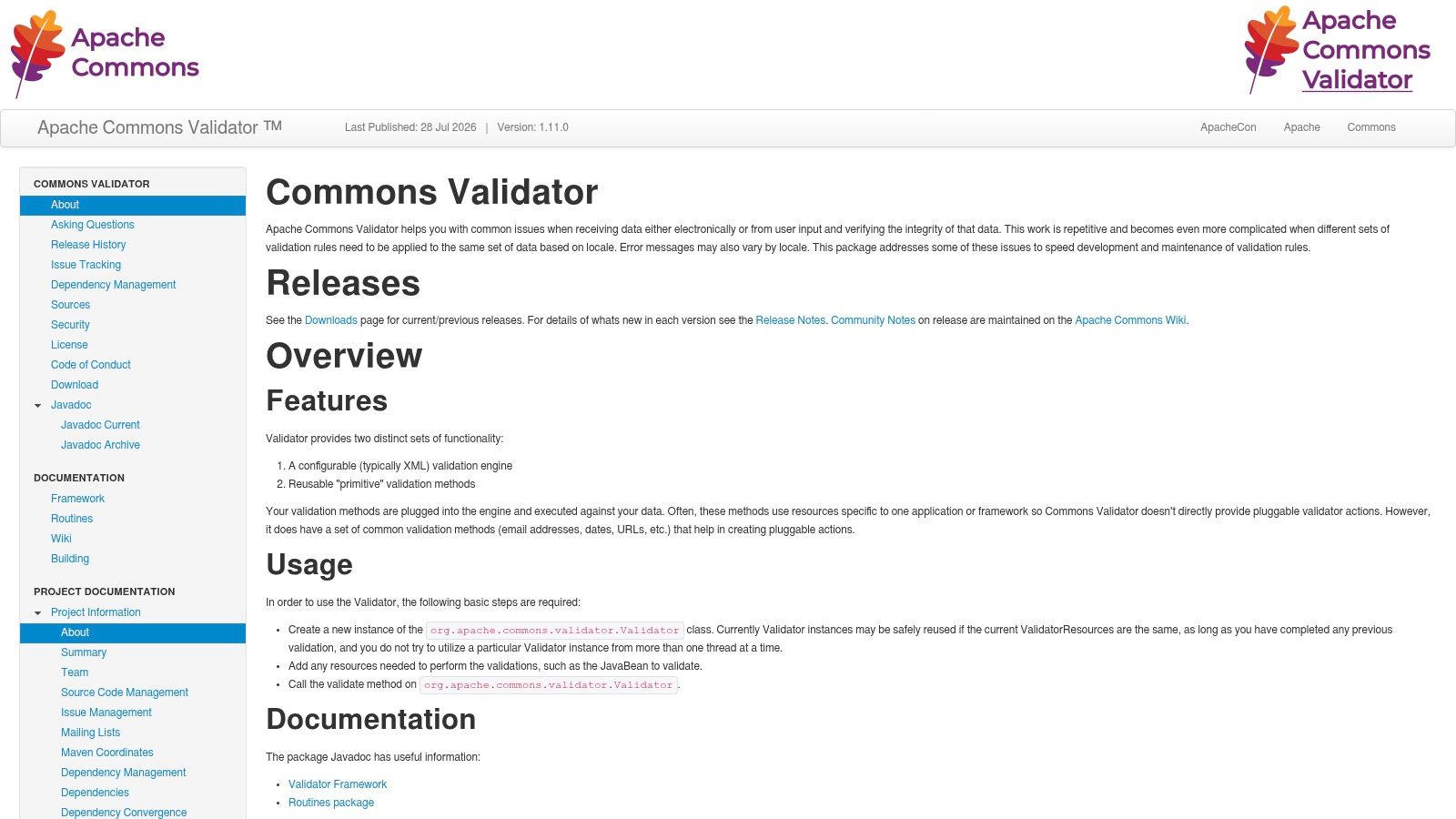
For a Java application already using Apache Commons, introducing a remote service just to reject malformed email input is usually unnecessary. Apache Commons Validator includes an email validator within its broader collection of input-validation utilities.
Verification ladder: local syntax and domain-format rules. Use org.apache.commons.validator.routines.EmailValidator, rather than the deprecated older class. Keeping that distinction explicit matters when developers copy examples from older codebases or search results.
The library fits applications that want email checks close to existing Java validation logic. Local execution also means there's no per-check API charge, although your team still owns dependency updates, configuration, and regression testing.
Keep the Result Narrow
Name the application result something like syntaxAccepted, rather than mailboxVerified. That small naming choice makes it harder for another developer to mistake a local validation result for evidence that a receiving server accepted the address.
- Good fit: Java services already relying on Apache Commons utilities.
- Trade-off: A broader validation dependency may be unnecessary if email is your only validation requirement.
- Missing evidence: The local result doesn't establish current mailbox availability or campaign suitability.
Apply the validator at the server boundary, then translate failures into actionable messages. Missing structure should produce a formatting prompt, not a claim that the user's inbox doesn't exist.
For campaign imports, retain the original address and store any normalized candidate separately. Apache Commons Validator can serve as the initial filter, but you'll still need domain checks, mailbox-risk assessment, and suppression handling before treating an imported list as ready to send.
5. Django EmailValidator
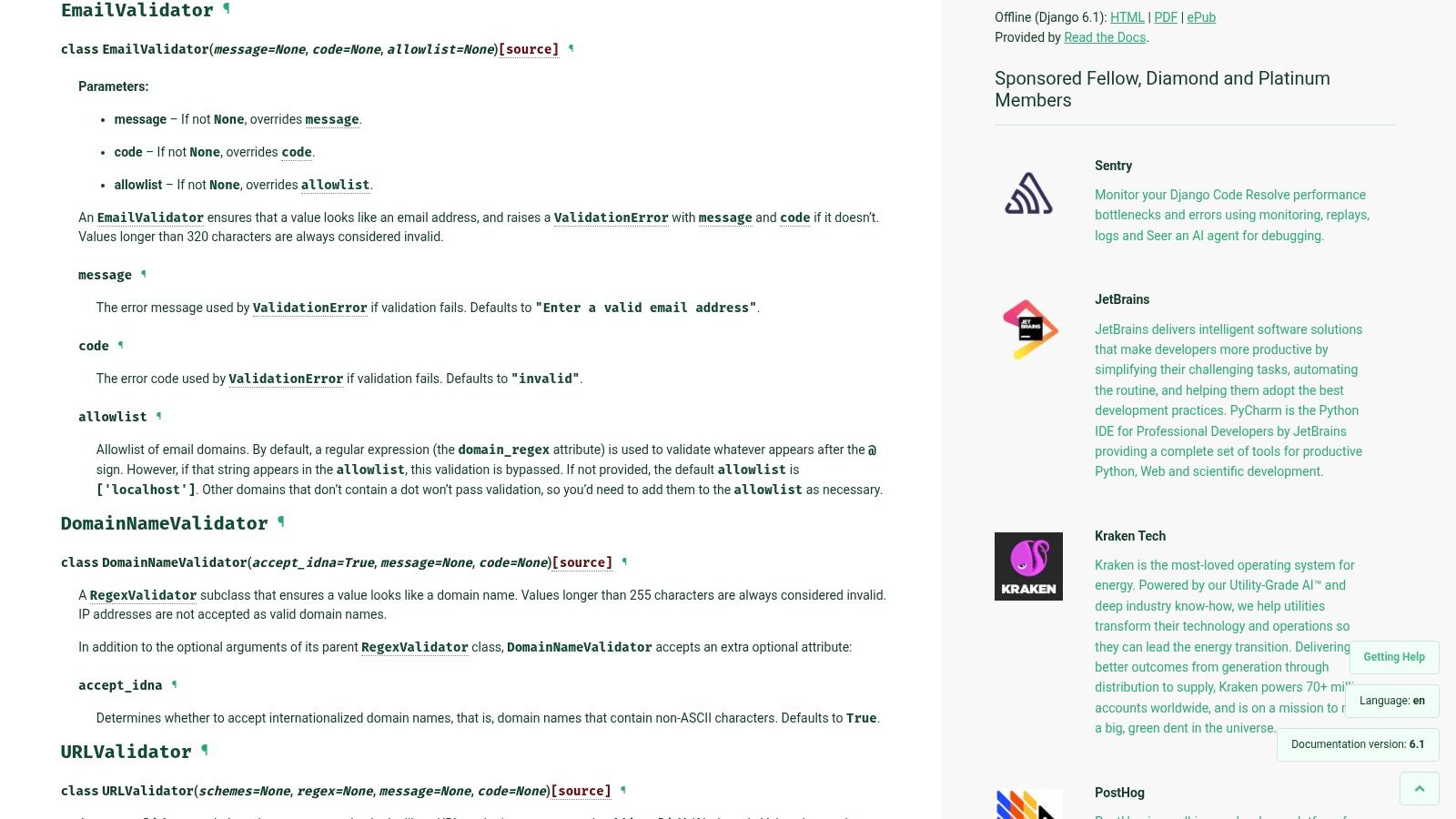
Verification ladder: syntax. If your application already uses Django, start with Django EmailValidator rather than installing another package for an equivalent format check. It checks whether a value looks like an email address and raises ValidationError when it doesn't.
Its strength is integration with Django's validation conventions. Forms and model fields can use familiar error handling, and you don't need a separate service account for basic validation.
Don't confuse attaching a validator to a model field with guaranteeing that every database write invokes it. Make sure API endpoints, background imports, and other write paths run the intended validation flow.
A framework validator protects the paths that call it. It doesn't automatically protect every route into your contact database.
Add Network Checks Outside the Format Validator
Keep local formatting errors separate from network-dependent verification outcomes. A malformed address can prompt an immediate correction, while a DNS timeout should produce a retryable or pending state rather than the same error message.
Our Python email validation guide explores the distinction between parsing an address and checking whether it's usable. In a Django application, that distinction should also appear in your stored fields and background jobs.
The limitation is straightforward: Django EmailValidator doesn't confirm mailbox existence, ownership, or permission to send marketing. It's also not a standalone choice for applications outside Django.
Use it for framework-native form hygiene. Add a confirmation flow for ownership and permission, and use a separate verification workflow when importing or rechecking campaign audiences.
6. node-email-verifier
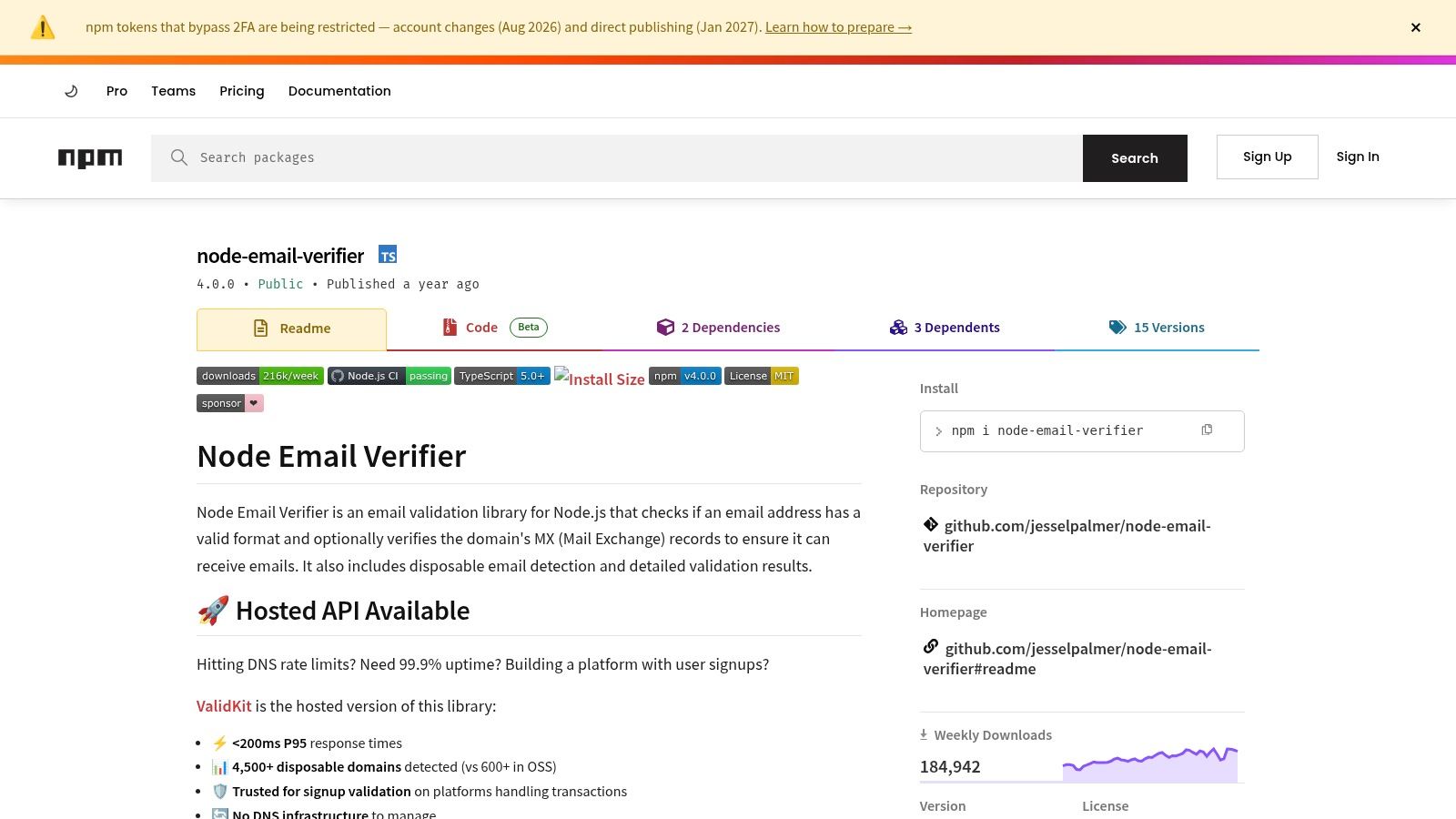
A domain-shaped string isn't evidence of a working mail domain. node-email-verifier moves beyond local formatting by offering optional MX-record checks and disposable-address detection.
Verification ladder: syntax plus domain-level signals. The node-email-verifier package listing describes format validation, optional mail-exchange checks, and detailed validation results. This makes it relevant to Node.js signup flows that need more context than a syntax Boolean.
The trade-off is operational: DNS introduces network dependency into a previously local decision. Configure timeouts, limit concurrent lookups, and distinguish a failed lookup from a conclusive finding that the domain can't receive mail.
Treat Domain Findings as Evidence
An MX result concerns the domain, not the particular local part before @. A disposable-provider flag is also a policy signal, not proof that the submitted mailbox is fake.
- Useful addition: Detect domain-level problems that a format-only check can't see.
- Implementation cost: Handle resolver failures, retries, caching, and asynchronous behavior.
- Remaining gap: Domain mail routing doesn't prove that the specific mailbox exists.
Before adoption, review the package's maintenance, tests, dependencies, and result semantics. Make sure you know whether a result reflects an actual failed check, an optional check that wasn't enabled, or a check that couldn't complete.
For signup, suggest a correction when you recognize a likely typo, but don't rewrite the user's address. For bulk campaigns, this package can contribute domain evidence; it doesn't supply the list-management workflow, mailbox-risk handling, or sending-policy decisions that a verification service can support.
7. Abstract Email Validation API
Verification ladder: syntax, domain, and mailbox-acceptance signals. Abstract Email Validation API is a hosted service rather than a local email validation library. It combines format, MX, SMTP, disposable-address, and catch-all checks in structured responses.
That changes what you need to build. Instead of maintaining mail-server probing infrastructure, you integrate an API, protect its credentials, and map its results to your application's decisions.
The service supports real-time and bulk validation, making it relevant when signup and import workflows need shared verification logic. The cost is an external dependency with network failures, usage billing, and privacy considerations that local syntax libraries don't introduce.
Mailbox Acceptance Is Still Probabilistic
A receiving server can obscure mailbox status or accept arbitrary recipients. Technical coverage of email-verification pitfalls explains how catch-all behavior, greylisting, throttling, and blocked SMTP access can make probes inconclusive.
Use an unknown or risky state instead of converting every uncertain result into invalid. Our guide to choosing an email address validation API provides a framework for evaluating those response fields and integration trade-offs.
Verification also doesn't prove that the person submitting the address controls it. Keep an ownership-confirmation step where appropriate, using confirmation email templates for app builders as a starting point for clear messages.
Abstract suits teams that want hosted verification evidence inside an application. It can't promise inbox placement, recipient engagement, or permission to send.
8. ZeroBounce
An imported contact list needs more than a loop around a form validator. You need to track verification outcomes, preserve uncertain records, and return results to the people preparing the send.
Verification ladder: hosted verification plus list-level risk signals. ZeroBounce offers single-address and bulk validation APIs, developer documentation, and language-specific wrappers. Its broader product set makes it relevant when developers and marketing operators need to work with the same verification service.
A ZeroBounce report analyzing lists submitted during 2022 found that 57.21% of addresses were classified as valid on first pass. That describes submitted lists, not all email databases, but it illustrates why an import shouldn't be treated as trustworthy merely because its rows resemble addresses.
Keep Verdicts Separate From Sending Policy
Store the provider's result alongside your application's final decision. A risky address may require review, while an unsubscribed address should remain suppressed regardless of a favorable verification result.
- Best fit: Teams needing both API integration and operational bulk-validation workflows.
- Main trade-off: An ongoing external service rather than a self-contained dependency.
- Integration concern: Slow or inconclusive mailbox checks need explicit timeout and retry behavior.
Before embedding a verification service into a product sold to others, review its current API-use terms. That's a different deployment from checking your own customer list.
ZeroBounce can supply verification evidence and bulk-processing capabilities. It can't turn a deliverable address into a permissioned recipient, and it shouldn't replace your application's suppression history or consent records.
9. Emailable
Verification ladder: hosted address verification with form and bulk integration options. Emailable offers an API, client libraries, bulk processing, a command-line interface, and an embeddable website widget. The choice is partly about how much integration work your team wants to own.
A widget can reduce front-end work for a newsletter subscription form. An API integration gives a backend more control over result storage, retries, and shared decision rules across signup, checkout, and imports.
Neither approach removes the need to define failure behavior. Decide what happens when the service doesn't respond, when a result is uncertain, and when a user insists that a flagged address is correct.
Integration advice: Let the browser help the user correct input, but let the backend enforce your final acceptance policy.
Choose the Integration Boundary Deliberately
For a widget, configure trusted domains and request limits rather than treating a public browser key as a secret. For server integrations, keep credentials out of client-side code and avoid logging full addresses unnecessarily.
- Widget route: Useful when the priority is adding verification feedback to an existing form.
- API route: Better when multiple application paths need consistent verification and audit records.
- Bulk route: Relevant when operators need to process imports rather than individual registrations.
Client libraries can reduce request-handling boilerplate, but your application still owns the meaning of each verdict. Preserve uncertain results instead of presenting them as permanent mailbox failures.
Emailable is a reasonable hosted alternative when integration flexibility matters. It's not a local-only library, and no widget or API response can establish that a verified recipient wants your next campaign.
What each email validation library checks, and what it costs to use
| Item | Mailbox Check | Domain or MX Check | Cost Model | Best For |
|---|---|---|---|---|
| validator.js | No; checks syntax only | No DNS/MX check | Free and open source | JavaScript projects needing configurable syntax validation and other input validators |
| @haraka/email-address | No; parses and validates syntax | No DNS/MX check | Free and open source | Mail-handling software parsing specialized address formats |
| isemail | No; checks address validity only | No DNS/MX check | Free and open source | Node.js backends needing a dedicated email syntax check |
| Apache Commons Validator | No; checks syntax only | No DNS/MX check | No per-check API cost for local validation | Java applications already using Apache Commons |
| Django EmailValidator | No; checks syntax only | No DNS/MX check | Built in; no separate service fee | Django forms and models |
| node-email-verifier | No; MX checks do not confirm mailbox existence | Optional MX-record check | Free and open source | Node.js signup flows needing domain-level signals |
| Abstract Email Validation API | SMTP check; results may be inconclusive | Format and MX checks | Free tier; paid monthly plans | Applications needing structured or bulk verification |
| ZeroBounce | Verification service; SMTP results may be unknown | Domain and MX checks | Free monthly credits; pay-as-you-go credit packs | Teams needing API integration and bulk validation |
| Emailable | Verification results may be uncertain | Domain and MX checks | Free trial credits; pay-as-you-go credit bundles | Teams wanting API, batch processing, or a website-form widget |
Read the table as a ladder. The first five rows stop at the format layer: they confirm a string is shaped like an address and nothing more. node-email-verifier adds one rung by asking DNS whether the domain publishes mail records. The bottom three rows climb to mailbox acceptance, where the receiving server is asked whether it would take the address. No row reaches list-level risk; consent, complaints, and engagement sit outside every option here.
Cost follows the same split. Local libraries charge nothing per check, so you pay in integration and upkeep. Hosted services meter each address, which means cost tracks signup volume and batch size, and an inconclusive result is still a request you paid for.
For a live form, a format check plus an MX lookup catches most typos without adding a network dependency to every keystroke. I'd reserve SMTP-level verification for imports and high-value addresses, where latency and per-request cost are easier to justify.
Choosing the Right Layer Before You Choose a Package
Choose an email validation library for the evidence it provides, not for how broadly its name defines validation. A local format checker is often exactly right for form hygiene, but it's the wrong tool for deciding whether an old campaign audience is ready to send.
For JavaScript applications, validator.js fits configurable input validation, while @haraka/email-address addresses specialized parsing needs. isemail offers a focused Node.js interface; Apache Commons Validator and Django EmailValidator fit their respective application ecosystems. These options help you enforce input rules without making network availability part of every formatting decision.
Match the Check to the Decision
Use domain checks when you need evidence about mail routing, and hosted verification when mailbox-level confidence matters. Keep list-level sending decisions separate, because verification results don't include every reason an address should be suppressed.
- At signup: Validate syntax, suggest likely typo corrections, and use domain or hosted checks where justified.
- During imports: Preserve the original file, verify addresses, and separate uncertain results from definite failures.
- Before sending: Recheck aged records and apply consent, unsubscribe, complaint, and engagement rules.
Authentication belongs in that final decision too. Proofpoint's guidance on stricter Google and Yahoo requirements explains the importance of SPF, DKIM, DMARC, alignment, and unsubscribe handling. Removing invalid addresses doesn't compensate for unwanted mail or poorly configured sending infrastructure.
Test With Your Own Address Corpus
Evaluate candidates against representative addresses you legitimately hold, with access controls appropriate to personal data. Include known syntax errors, legitimate unusual formats, domain failures, catch-all results, and temporary network failures.
Measure false rejection, uncertainty, and operational behavior, not just how quickly the happy path completes. Store the check time and reason alongside the result so another developer can understand why the application accepted, deferred, or rejected an address.
If you Hire Developers to implement the workflow, make those result states and failure paths part of the acceptance criteria. Require tests showing that a timeout doesn't become a permanent rejection and that a favorable verification verdict never overrides an unsubscribe.
CleanMyList is another option for bulk cleaning and real-time signup checks, with 50 free credits and no card required. Whatever you choose, keep syntax acceptance, mailbox confidence, and permission to send as separate decisions. That separation makes the system easier to explain, test, and change without accidentally rejecting real users or mailing suppressed contacts.
CleanMyList lets you upload or paste a list for bulk verification, or check addresses through an API at signup without sending verification emails to those contacts. Visit CleanMyList to test a representative sample, review the plain-English reasons behind each verdict, and export the results before your next send.