
A clean email list doesn't guarantee inbox placement. That advice is attractive because it turns a difficult systems problem into a simple pass or fail decision, but it isn't how deliverability works. An email checker API can remove malformed, nonexistent, disposable, and risky addresses before they damage your sending reputation. It can't make an unwanted message relevant, repair weak authentication, or force a mailbox provider to place your campaign in the inbox.
That distinction matters. One benchmark found that the average bounce rate across industries was 1.01%, with ecommerce at approximately 0.57%, while guidance generally treats a rate below 2% as safe. Providers may begin throttling senders above 4% to 5% and suspend accounts around 8% to 10%, according to Sender's email marketing benchmark summary. A list of 100,000 addresses can therefore still generate roughly 1,010 bounces at the average rate.
Verification is best understood as risk reduction and decision support. It protects the data entering your CRM, form, or campaign platform, then gives your team enough signal to decide whether an address should be accepted, suppressed, reviewed, or tested cautiously.
Table of Contents
- Redefining the Role of Email Verification
- Core Signals and the SMTP Advantage
- Integration Options and API Architecture
- Decisioning Under Uncertainty for B2B Lists
- Evaluating Privacy and Provider Reliability
- Pricing Models and Credit Economics
- Building a Sustainable List Hygiene Workflow
Redefining the Role of Email Verification
The popular promise is simple: verify the list, send with confidence, and watch inbox placement improve. The operational reality is more conditional. Verification reduces exposure to bad recipient data, but sender reputation, authentication, content, engagement, complaint behavior, and list age still influence what happens after a message leaves your system.
A useful benchmark cited in email testing and deliverability research found that inbox placement had fallen to 83.5% in 2024, with 6.7% of messages landing in spam and 9.8% blocked or delayed. The same source reports that one out of every six legitimate marketing emails failed to reach the inbox, while another benchmark measured an average inbox placement rate of 83.1% across 15 email service providers. The practical lesson is uncomfortable but important: a provider can accept a message for delivery without placing it where a recipient is likely to see it.
What an API can control
An email checker API operates upstream of the send. It can inspect whether an address is syntactically plausible, whether its domain is configured to receive mail, whether the mailbox appears to exist, and whether the address carries known risk signals. That makes it valuable at signup, during CRM imports, before a campaign, and when rechecking an aged database.
It can't validate consent, judge whether your offer is useful, or predict every mailbox provider's filtering decision. It also can't turn a role address into a personal relationship or make an old contact current again.
Practical rule: Treat verification as a gate on recipient quality, not as a guarantee of inbox placement.
This changes how product teams define success. Instead of promising a mythical 100% delivery rate, measure whether fewer invalid records enter your systems, whether hard bounces remain within your acceptable operating range, and whether uncertain verdicts receive a deliberate policy. A clean list is an input to deliverability work, not the finished result.
The right expectation
The strongest implementation combines verification with authenticated sending, permission-based acquisition, relevant content, complaint monitoring, suppression management, and engagement analysis. Verification removes preventable failures so those other controls can work against a cleaner data set.
That is why the question shouldn't be, “Will this API guarantee inbox placement?” Ask instead, “Which risks does it identify, how transparent are its verdicts, and what decision can our system make from each result?” That framing produces better integrations and fewer dangerous assumptions.
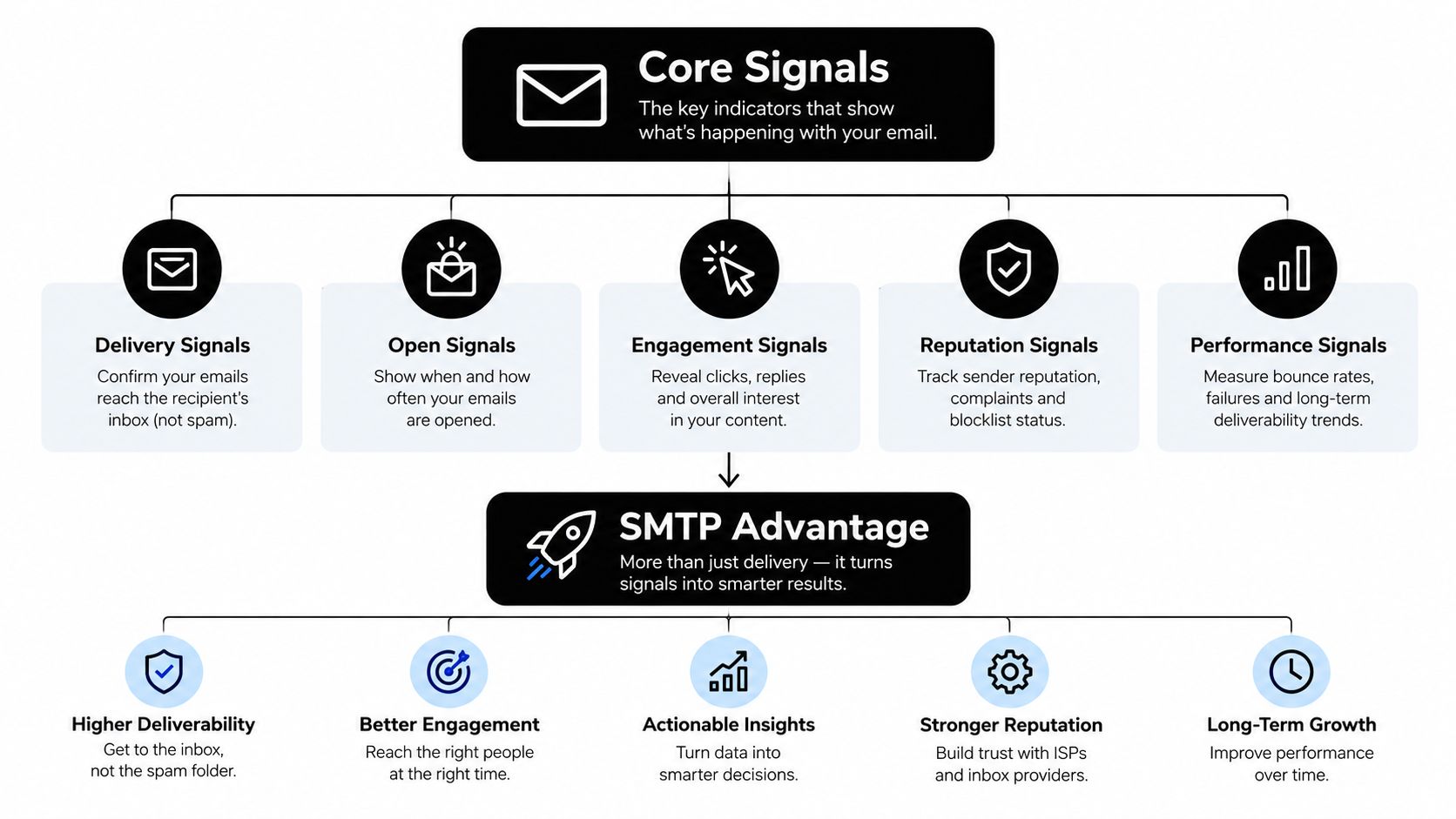
Core Signals and the SMTP Advantage
A reliable email checker API should return more than a green checkmark. It should expose the evidence behind its recommendation, because a syntactically correct address on a valid domain can still point to a mailbox that doesn't exist.
The usual verification layers begin with format and domain checks, then move toward mailbox-level signals:
- Syntax: Detect malformed structures, invalid characters, and obvious input errors.
- Domain and DNS: Establish whether the domain is configured to receive mail.
- SMTP mailbox response: Probe whether the receiving server accepts the specific mailbox.
- Catch-all behavior: Identify domains that accept mail for almost any address, making existence difficult to confirm.
- Disposable providers: Flag temporary inbox services that create short-lived or low-quality records.
- Role accounts: Identify addresses such as general departmental inboxes that may not represent an individual contact.
- Historical bounce reputation: Add context from prior delivery behavior where the provider supports it.
- Final recommendation: Convert the signals into a usable result such as send, skip, or review, with a reason.
Why DNS alone produces false confidence
DNS or MX validation answers a narrow question: does this domain have mail infrastructure? It doesn't answer whether the named mailbox exists. A company can maintain a perfectly configured domain while employees leave, aliases change, and old addresses disappear.
The difference is material. In a representative 50K-row B2B list, DNS-only validation marked 96.2% of records as valid, while full SMTP verification reduced the true valid rate to 71.4%, a 24.8-point gap. The breakdown included 15.1% non-existent mailboxes on valid domains, 7.3% catch-all domains, and 2.4% disposable or role addresses, as described in this SMTP versus DNS verification analysis.
An SMTP verifier uses an RCPT TO probe to ask the receiving server whether it accepts the specific recipient. That is much more informative than checking domain configuration, although it still isn't an absolute promise. Some servers deliberately obscure mailbox status, accept all recipients temporarily, or use policies that make the response ambiguous.
For a practical explanation of mailbox existence checks, see how to check if an email address exists. The important engineering requirement is that your API preserves distinctions between valid, invalid, catch-all, unknown, and risky, rather than collapsing every response into pass or fail.
The SMTP conversation is deliberately non-delivery. A responsible verifier doesn't send a message to the recipient. It observes the receiving server's response and records the result, which is why provider privacy and probing policies deserve review before production use.
A short walkthrough can help engineers connect these signals to the broader verification workflow:
Integration Options and API Architecture
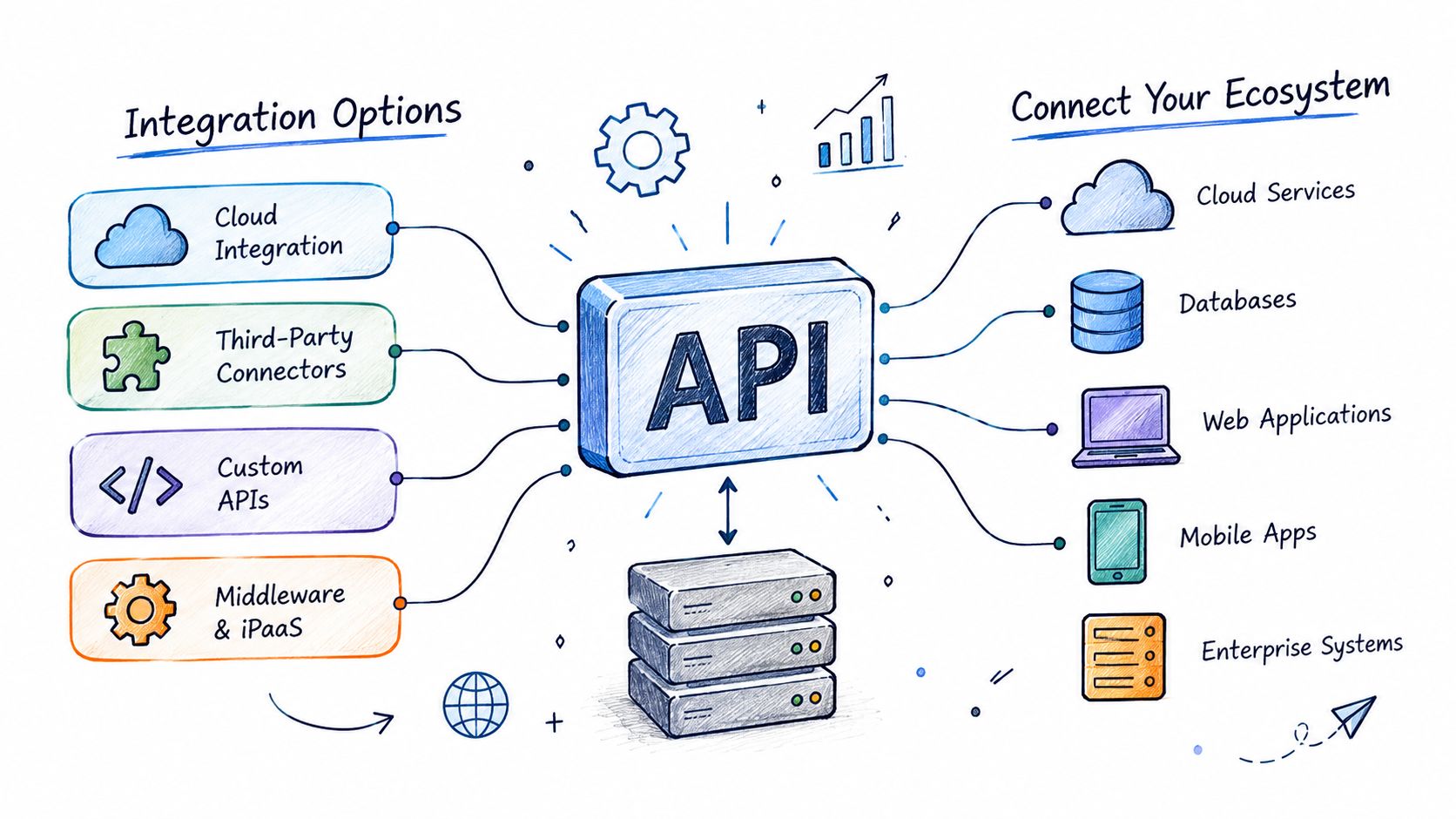
An email checker API usually fits into an application as a small REST service. Your backend authenticates with a token, sends an address to a single-record endpoint, and receives a structured response containing a verdict, supporting signals, and sometimes a reason code. Bulk workflows use a job endpoint or file upload, then return results asynchronously so a large list doesn't hold open a web request.
A typical request might contain an email address and an internal reference such as a user ID. A useful response should separate fields rather than returning only valid: true. Your application might need to distinguish:
- Accept: Store the address and permit the next workflow.
- Reject: Show a correction message or prevent the record from entering the database.
- Review: Preserve the record but exclude it from automated sending.
- Unknown: Route it to a policy designed for unresolved infrastructure responses.
Real-time checks at the point of capture
Real-time validation belongs in the signup or lead form when a typo would otherwise become a permanent database record. The frontend can provide immediate feedback, but the server must repeat the check because client-side controls can be bypassed and API credentials shouldn't be exposed in browser code.
Keep the user experience tolerant. A slow verification response shouldn't erase the form or block a legitimate person indefinitely. Set a timeout, record the event, and use a fallback state such as “pending review” when the provider is unavailable. Don't automatically accept every failed API call as valid, because an outage can then turn into a wave of unverified records.
The same principle applies to rate limits. Queue non-urgent checks, retry transient failures with backoff, and make retries idempotent so one address doesn't consume unnecessary credits. For implementation patterns, email API integration guidance is a useful reference point.
Batch processing needs different controls
Bulk verification should run outside the request path. Upload the source file unchanged, create a job, monitor progress, and write results to a new dataset. Preserve the original address, source, consent metadata, and CRM identifier so the team can audit why a record was accepted or suppressed.
A product team should also define what happens when the service is delayed. A campaign scheduler can require a completed job before launch, while a sales workflow can allow a representative to see an “unverified” label without treating it as approval. Teams comparing providers may also find practical guidance on how to boost sender reputation with API, provided they keep verification separate from the other controls that influence delivery.
Decisioning Under Uncertainty for B2B Lists
An email verification API cannot turn incomplete evidence into certainty. Catch-all addresses demonstrate the limit clearly. A catch-all domain accepts mail for addresses that may not exist, so an SMTP probe cannot reliably confirm the individual mailbox. The API has not necessarily failed. The recipient infrastructure has merely withheld the signal your decision requires.
That outcome is common enough to justify a defined policy. Market commentary estimates that 8.6% to 15.25% of B2B addresses may be catch-all, according to analysis of the bulk email verification market. Suppressing every uncertain address can remove genuine prospects. Sending to every unresolved address increases exposure to bounces and reputation problems.
Use a three-lane policy
Send addresses that meet the signals your team requires. A typical rule includes valid syntax, an operating domain, a positive mailbox response, and no strong disposable or risk indicator.
Suppress clearly invalid addresses, prohibited disposable addresses, and records associated with a hard failure. A sales representative should not override a technical rejection without new evidence, such as a confirmed reply address.
Stage catch-all and unknown records in a controlled pool. Keep them out of the primary campaign, retain their source and owner, and decide whether their relevance and permission justify a limited test. Cold outbound requires a stricter threshold because the recipient may not expect contact. A customer relationship or confirmed opt-in can support a different decision.
Unknown means the system lacks enough evidence for an automatic send decision. It does not establish validity or invalidity.
Make the policy observable
Store the raw verdict, reason, timestamp, campaign, and resulting action. This record lets the team compare later outcomes without treating the original API response as more certain than it was. A reply, completed transaction, or corrected form can support a later approval. A hard bounce should move the address into suppression.
A test pool is not permission to send indiscriminately. Keep the message relevant, follow consent and opt-out requirements, monitor bounces and complaints, and stop the test when results turn negative. The objective is controlled exposure while preserving a route to recover potentially valuable contacts.
List age adds another source of uncertainty. One 2026 report found that only 62% of submitted emails were valid and that list decay reached 23% in 2025, as reported in the same market analysis linked above. Reverify based on record age, campaign importance, or changes in the source system. Waiting for a sudden bounce spike means the list has already created delivery risk.
Evaluating Privacy and Provider Reliability
A fast API can still be the wrong API if it handles your contact database carelessly. Email addresses are personal data in many contexts, and a verification workflow can expose customer, prospect, employee, or subscriber records to a third party. Review the provider's processing terms, retention window, deletion controls, access model, encryption practices, and subprocessors before uploading production data.
The most important question is simple: does the service send an actual email during verification? It shouldn't. Verification should use non-delivery checks and mailbox responses, not a hidden message that creates an unsolicited contact event or contaminates your engagement data.
Compare providers by operational behavior
| Evaluation area | Questions to ask |
|---|---|
| Retention | How long do uploaded addresses and result files remain available? Can you request deletion? |
| Security | Is data encrypted in transit and at rest? Are API keys scoped and rotatable? |
| Access | Can administrators control team access and audit activity? |
| Reliability | What happens during latency, outages, or provider throttling? |
| Verdicts | Does the response expose reasons and uncertainty, or only a binary status? |
| Commercial terms | Do credits expire, and are unknown results charged? |
Don't evaluate accuracy from a polished dashboard alone. Run representative test data that includes malformed inputs, role addresses, disposable domains, dormant contacts, and domains known to behave like catch-alls. Compare the returned classifications with your own delivery events, then repeat the exercise after provider changes.
Provider throttling also deserves attention. If a vendor reacts to changing bounce patterns by restricting your verification account, your campaign controls can fail at the moment you need them most. Build a queue, preserve failed jobs, and make it possible to switch providers or pause sending without losing the original list.
For a broader comparison checklist, use this guide to the best email verification services. The selection should reflect your data sensitivity, traffic pattern, integration surface, and tolerance for unresolved results, not just headline speed.
Pricing Models and Credit Economics
Verification costs become difficult to manage when the pricing model assumes a steady monthly campaign cadence. Startups may acquire leads in bursts, ecommerce brands may clean lists around seasonal activity, and outbound teams may change volume as territories or offers change. A fixed subscription can leave you paying for capacity you don't use, while punitive overages make a successful campaign unexpectedly expensive.
For those patterns, pay-as-you-go credits are usually the more rational default. You buy capacity when a real workflow needs it, then match spending to the number of addresses processed. Non-expiring credits are especially useful because list cleaning is operational rather than perfectly periodic.
Calculate the real unit cost
Don't compare only the advertised price per credit. Ask what counts as a billable verification and whether the provider charges for:
- Unknown results: A service that charges for unresolved catch-all records may cost more for B2B data than its headline rate suggests.
- Retries: Temporary failures shouldn't create duplicate charges.
- Bulk jobs: File processing may have separate minimums or limits.
- Rechecks: Aged-list hygiene can consume credits again, so model it as recurring operational work.
- Exports and integrations: Some vendors bundle these features, while others restrict them by plan.
A free trial without a credit card is useful for testing API behavior, response fields, latency, and error handling. It should be treated as an evaluation environment, not as proof that the provider will perform consistently on your own data.
The right comparison is your effective cost per actionable decision. If a cheap verifier returns opaque results that force engineers to build a second classification layer, the initial saving may disappear. A slightly different credit model can be preferable when it gives your team clear reasons, predictable retries, and credits that remain available for the next cleanup cycle.
Building a Sustainable List Hygiene Workflow
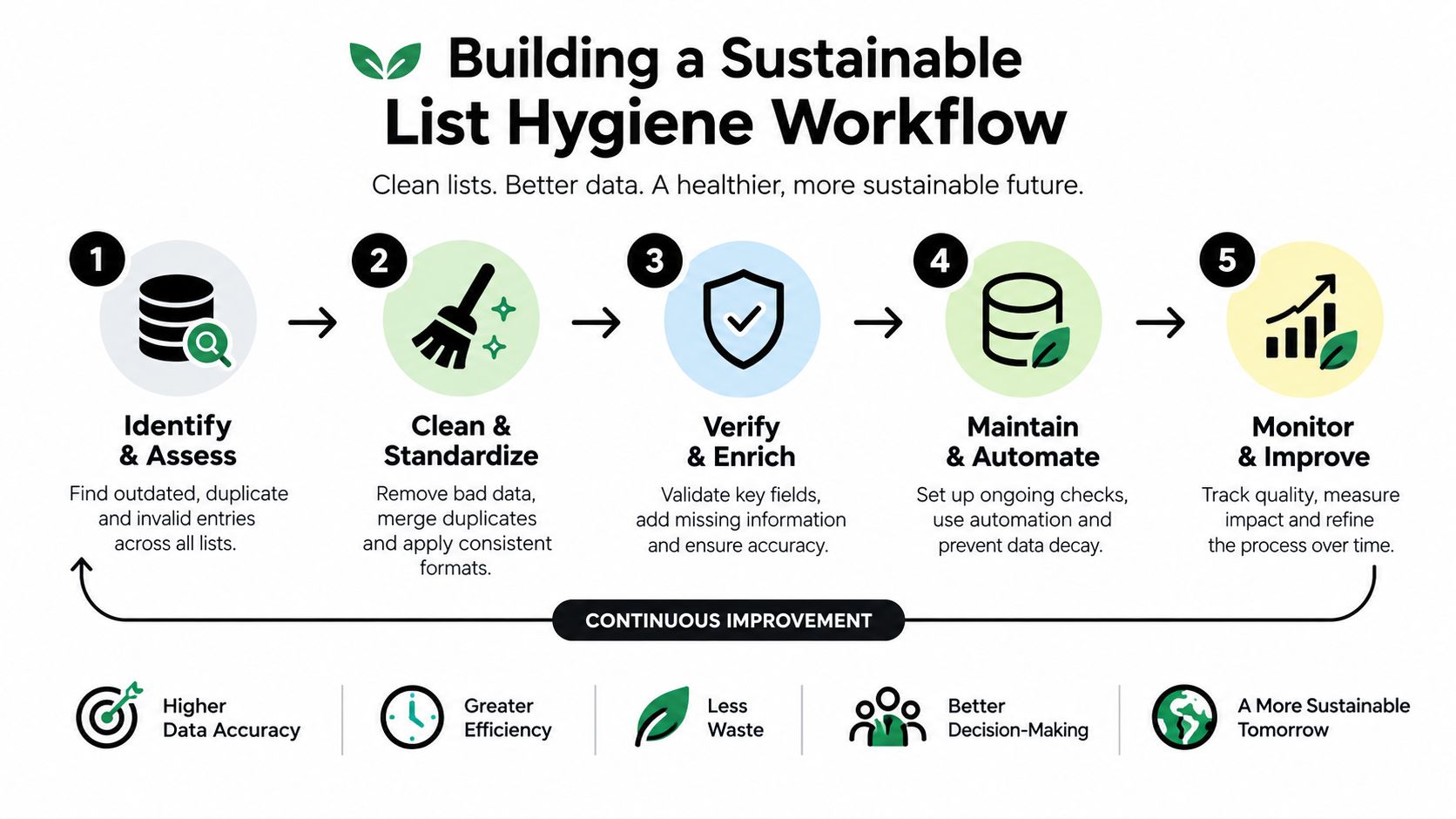
List hygiene works best as a controlled data process, not a last-minute button before a campaign. Start by identifying where addresses enter your systems, then apply the lightest suitable check at each point. Signup forms need fast synchronous validation. CRM imports and campaign databases benefit from asynchronous bulk jobs.
A practical workflow looks like this:
- Capture at the source. Add server-side verification to forms and signup flows. Stop obvious typos and fake addresses before they reach the primary database, while sending slow or unavailable checks to a review state.
- Preserve the original. Keep the source CSV or database export unchanged. Create a working copy with stable record IDs, acquisition source, consent fields, and existing suppression history.
- Run layered bulk verification. Process the working copy through syntax, domain, SMTP, catch-all, disposable, role, and reputation signals. Don't overwrite the source address or erase the reason for a verdict.
- Apply decision rules. Export separate valid, invalid, risky, and unknown segments. Suppress clear failures, review uncertain B2B addresses, and document who approved any staged send.
- Monitor and reverify. Feed bounce, complaint, unsubscribe, and reply events back into suppression and CRM systems. Recheck aged lists before important campaigns rather than assuming a previous pass remains current.
Keep verification separate from sending
A verifier should improve the input to your email service provider, not become a hidden sending layer. Export only the segment approved for the next campaign, retain the uncertain group for a separate decision, and make suppression updates flow back to every system that could send.
Healthy programs commonly aim to keep total bounce below 2%, with hard bounces ideally below 1%, while deliverability can degrade above 2% to 5%, according to guidance on the role of email verification. Those thresholds are warning signals, not universal guarantees. Use them alongside complaint rates, authentication results, engagement, and mailbox-provider feedback.
CleanMyList offers bulk CSV verification, real-time verdict streaming, export or email-tool syncing, and API endpoints for single-address and bulk checks. It returns signal-level reasons, preserves the original list, doesn't send emails during verification, and uses a no-subscription credit model with non-expiring credits. Visit CleanMyList to test the workflow with the free starting credits, connect signup validation, or clean a list before your next send.