Does nationwide service tell you enough about an insurance-audit provider, or does the more important question concern how it checks the work? For anyone evaluating Mountain Creek Solutions, the useful distinction is between company statements, third-party profile estimates and evidence of client outcomes. Those categories support different conclusions, and they shouldn't be treated as interchangeable.
Table of Contents
- MountainCreek Solutions at a Glance
- Leadership Background and Field Experience
- What a Premium Audit Checks After Coverage Starts
- Physical, Virtual and Telephone Audits Compared
- Reputation Signals and Gaps in the Public Record
- Check These Points Before You Engage MountainCreek
MountainCreek Solutions at a Glance
MountainCreek Solutions is a privately held insurance-services company in Uniontown, Pennsylvania, focused on premium audits and loss-control work for commercial insurers rather than selling insurance directly. The ZoomInfo company profile places its founding in 2019 and supplies the company-profile details summarized below.
MountainCreek Solutions company profile
| Attribute | Detail | Source type |
|---|---|---|
| Headquarters | 30 E. Main Street, Suite 300, Uniontown, Pennsylvania | Company profile data |
| Founded | 2019 | Company profile data |
| Ownership | Privately held | Company profile data |
| Industry codes | SIC 6411, Insurance Agents, Brokers, and Service; NAICS 5242, Agencies, Brokerages, and Other Insurance-Related Activities | Company profile data |
| Business focus | Premium-audit and loss-control services for commercial insurance | Company site and profiles |
| Estimated size | 6–10 employees in one directory; fewer than 25 employees and annual revenue below $5 million in another | Third-party directories |
| Service reach | Physical audits across the lower 48 states; phone and virtual audits in all 50 states | Company statement, not independently verified |
The directory estimates suggest a boutique specialist, not a large national insurance-services organization. That doesn't establish either superior customization or limited capacity. A buyer needs evidence about staffing availability, supervision and account allocation before drawing either conclusion.
Say a contractor receives an audit request bearing the company's name. The immediate task isn't to compare insurance quotes. It's to establish which carrier commissioned the work, what records are needed and where those records should be submitted.
Identity check: Confirm the commissioning insurer and the approved upload channel before sharing payroll or employee information.
The headquarters address is the only contact detail established in the available profiles. They don't establish a verified phone number or email address. Physical coverage also requires confirmation because company and third-party descriptions differ.
For fleet operators organizing supporting safety documentation, My Safety Manager offers a resource to manage fleet safety records. That is a separate recordkeeping resource, not evidence about MountainCreek's audit procedures.
This profile describes public information, not audited financial results or independently measured service quality. Don't confuse the insurance-services business with the similarly named Mountain Creek Resort.
Leadership Background and Field Experience
MountainCreek's leadership account describes a progression from field assignments into management. Its published team biography says President Abby Davis began as a field premium auditor and loss-control consultant before moving into operational and sales leadership; it also credits Office Administrator and Customer Service Manager Sam Carpenter with more than 25 years of insurance and audit-services administrative and customer-service experience.
The leadership background material also describes Michael George as having more than 11 years in premium audit and loss control, alongside family roots in the sector. That experience belongs to the individuals described. It shouldn't be treated as a company-wide training credential or a guarantee about whoever receives a particular assignment.
Field experience is relevant because records don't always explain business activities cleanly. Consider a contractor whose payroll report groups installation crews, delivery staff and office personnel under broad internal department names. An auditor needs to understand what those employees do, rather than copying the employer's labels.
A leader who has worked through those files may understand the practical difficulties involved. However, that background only benefits an individual account if the company translates it into usable instructions, supervision and escalation procedures.
Experience isn't the same as a quality system
Buyers should distinguish leadership experience from repeatable execution. A biography can establish a relevant career history, but it doesn't show how an unfamiliar operation is reviewed or how a junior auditor's judgment is checked.
Useful questions include:
- Assignment ownership: Who will conduct the audit, and who will review the completed file?
- Relevant training: Has that auditor handled businesses with comparable operations?
- Technical escalation: Who resolves an uncertain classification or conflicting record?
- Continuity: Who takes responsibility if the assigned auditor changes?
Administrative experience matters too. Scheduling, document tracking and clear explanations can determine whether a policyholder supplies usable evidence or repeatedly resends incomplete files.
Confirm current roles before relying on a published biography. The strongest procurement question isn't whether executives have worked in the field. It's how their experience reaches the person handling your account.
What a Premium Audit Checks After Coverage Starts
A premium audit compares the exposure estimates used to price an auditable policy with the business's actual activity during the covered period. It's a reconciliation process, not automatically a finding that the business did something wrong.
The precise records and calculations depend on the policy. Common review areas include payroll by job classification, the operations performed, business locations and exposure bases such as payroll or sales. The auditor's task is to establish the relevant facts and document how they relate to the policy.
The illustration below shows the kinds of records involved.

A contractor's reconciliation
Suppose a contractor estimated a stable installation crew but later hired seasonal workers and accepted jobs involving different activities. The auditor would need payroll registers, job descriptions and supporting work records to understand the change.
Higher headcount alone doesn't settle the premium calculation. The relevant questions include how much payroll was incurred, what work employees performed and which policy classifications apply. A change in duties calls for investigation, not an automatic assumption that every employee belongs in a different class.
The reconciliation can work in either direction. Actual exposure above the estimate may support additional premium, while lower exposure may support a return, subject to policy terms and applicable minimums.
A useful audit trail connects each adjustment to a record, an explanation of the work and the applicable policy treatment.
A premium audit differs from a loss-control inspection, which examines hazards and risk-management conditions. It also differs from an underwriting review, through which an insurer evaluates whether and on what terms to accept a risk.
Those activities can involve overlapping information, but their purposes aren't identical. Before preparing records, ask whether the assignment concerns premium reconciliation, loss control or both. Don't assume a site visit authorizes every type of review, or that a remote appointment limits the auditor to a brief conversation.
Physical, Virtual and Telephone Audits Compared
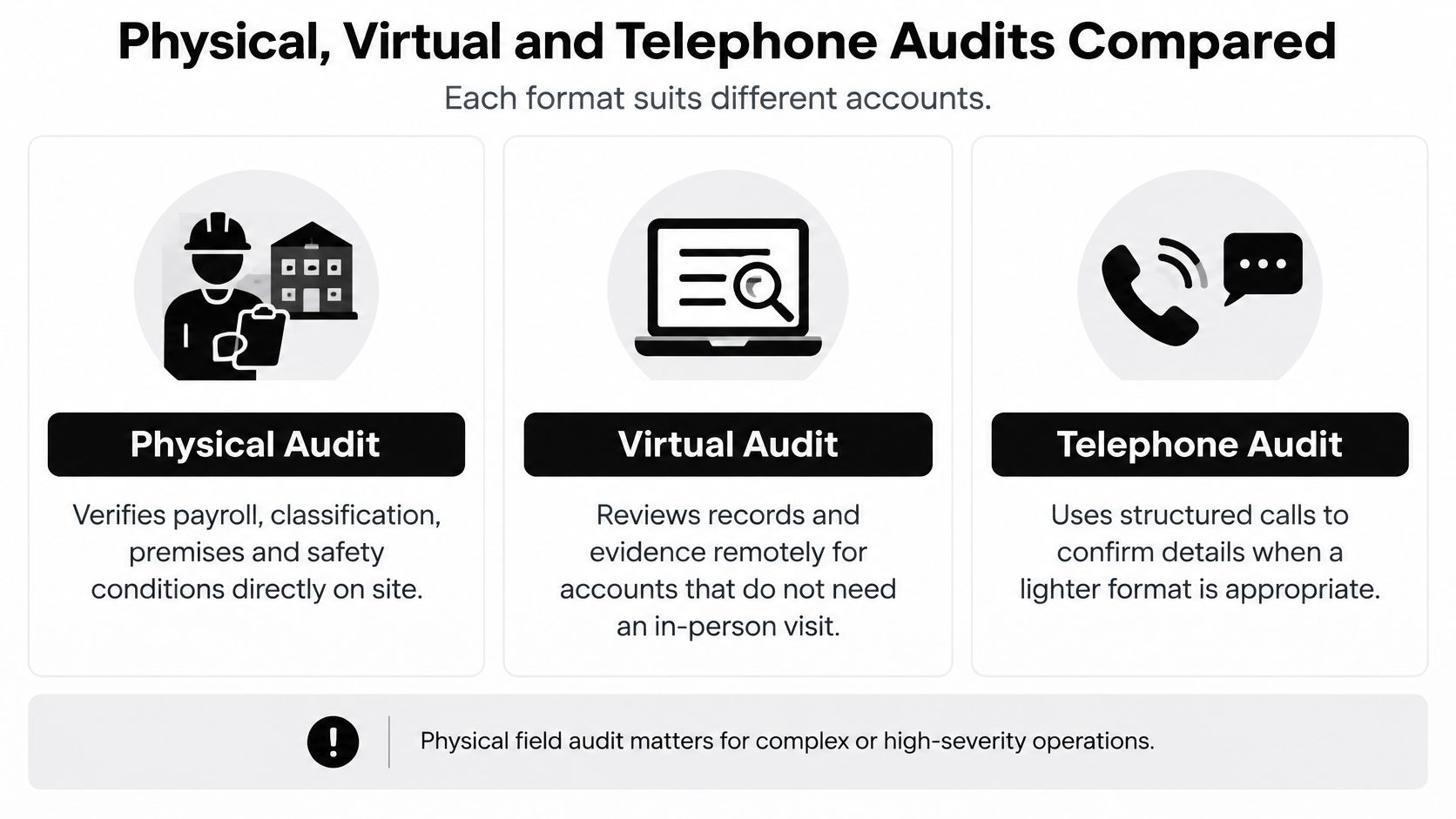
Choose the format around the evidence required, not around convenience. A straightforward account with organized records may be suitable for remote review, while an operation with unclear activities may need direct observation.
The following comparison illustrates the distinctions between formats.
Audit formats and where they are offered
The ContactOut company profile describes physical field work east of the Mississippi River and phone and virtual audits nationwide, a narrower physical footprint than the company's stated lower-48 reach; its nationwide remote description corresponds to all 50 states.
| Format | Coverage | Best suited for |
|---|---|---|
| Physical field audit | Broader footprint claimed by company; narrower eastern footprint in third-party profile | Complex, high-severity or hard-to-verify operations |
| Telephone audit | Nationwide | Lower-complexity accounts with clean records |
| Virtual audit | Nationwide | Lower-complexity accounts with complete digital records |
The coverage discrepancy doesn't prove either description is wrong. It could reflect an outdated profile or a difference in service arrangements, but neither explanation is established. Obtain written confirmation for the actual locations involved.
Physical work permits on-site verification of operations and premises. Telephone review relies on structured questioning and supporting documentation, while virtual work can combine digital records with remotely supplied evidence. Ask what each label means in the proposed scope rather than assuming a standard package.
Route accounts by complexity
A practical starting rule is to direct complex or high-severity operations toward physical review and use remote methods for simpler accounts with coherent records. Missing documentation should trigger a discussion about additional evidence or a site visit, not an unsupported conclusion.
Carriers can compare exceptions, corrections and rework across formats. Faster completion alone doesn't establish better accuracy, and the available profile doesn't publish audited accuracy, turnaround or loss-ratio benchmarks.
For broader personnel-record preparation, Paradigm International Inc.'s a practical guide to modern HR audits offers a separate perspective. An HR audit isn't an insurance premium audit, so keep their objectives and document requests distinct.
Hybrid and commercial-survey audits also appear in the service portfolio, but their scope isn't clearly established in the public descriptions. Request deliverables, evidence requirements and escalation triggers in writing.
The embedded video is supplemental material, not verification of MountainCreek's service commitments.
Reputation Signals and Gaps in the Public Record
The most visible reputation signal concerns employee experience rather than client outcomes. Indeed's MountainCreek Solutions reviews show low aggregate assessments across management, culture, compensation and job security, while reviews posted in 2024 and 2025 allege poor communication, changing compensation terms, turnover and inadequate training.
These are employee allegations, not independently verified findings. They warrant questions, but they don't establish inaccurate audits, improper premium adjustments or deficient service for a particular client.
The following conceptual illustration isn't a screenshot of MountainCreek reviews or independent evidence about the company.
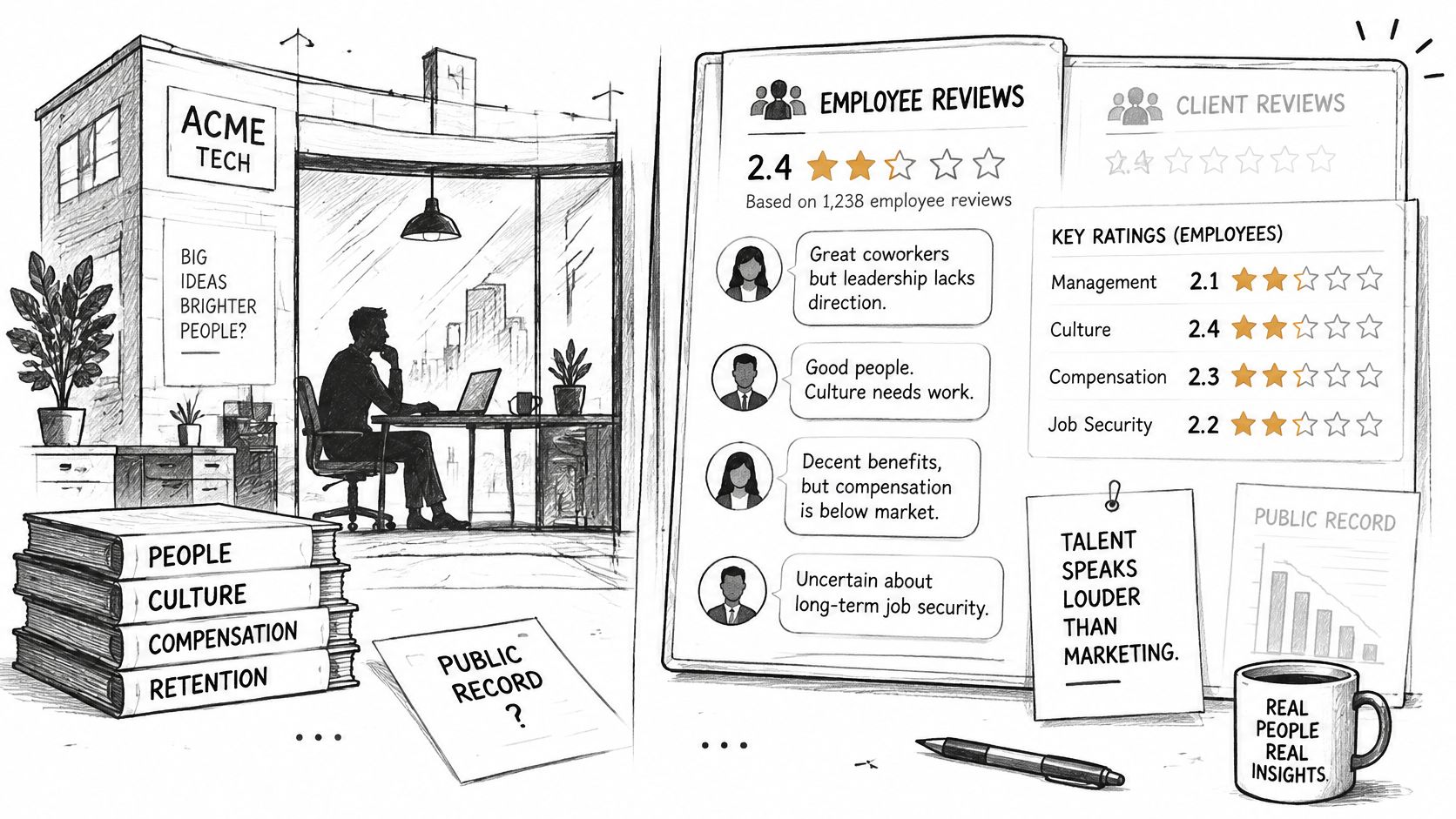
What employee reviews can and can't establish
A dissatisfied employee may describe a genuine operational problem, an individual dispute or circumstances that no longer apply. Public reviews generally don't provide enough supporting material to distinguish those possibilities reliably.
The buyer's concern is narrower and testable. If training or staff continuity is weak, does the provider have controls that prevent inconsistent judgments from reaching the insurer?
Consider a hypothetical handoff between auditors. If the incoming auditor can't see why a classification was selected, the replacement may ask for the same records again or reach a different conclusion. A documented review trail would make that handoff easier to inspect and correct.
That scenario explains a possible mechanism. It isn't evidence that MountainCreek has experienced it.
Negative employee reviews justify closer examination of operational controls. They don't substitute for evidence of client-facing performance.
The missing evidence buyers should request
The available public coverage doesn't establish the following safeguards or outcomes:
- Auditor qualification: Credentialing requirements, relevant training and authorization to handle specialist accounts.
- Review controls: Quality-control sampling, supervisor sign-off and checks on disputed classifications.
- Information governance: Data-security procedures, access controls and conflict-of-interest management.
- Service accountability: Turnaround commitments, complaint handling and a documented dispute-resolution route.
- Measured results: Audit-error rates, rework rates and comparable client-outcome reporting.
A lack of public disclosure doesn't prove a lack of internal procedures. It does mean a prospective buyer can't assess those procedures from the visible record alone.
Remote auditing makes standardized evidence requests especially important. Reviewers need to identify which files support a conclusion, what clarification was requested and who approved a change. A completed report without that trail may be difficult for another reviewer to evaluate.
Client references, defined error and rework measures, and documented quality procedures would provide a stronger basis for selection than either reassuring biographies or unfavorable employee commentary. Ask how each metric is defined, since an error corrected internally isn't necessarily counted the same way as a client complaint.
Check These Points Before You Engage MountainCreek
Treat the public profile as a starting point, not a complete service specification. The Salary.com company overview identifies an insurance premium-audit business, not an email-marketing or email-verification service; the available descriptions don't establish a complete customer workflow or dispute process.
Use the visual as a preliminary prompt, then obtain written answers to the fuller checks below.
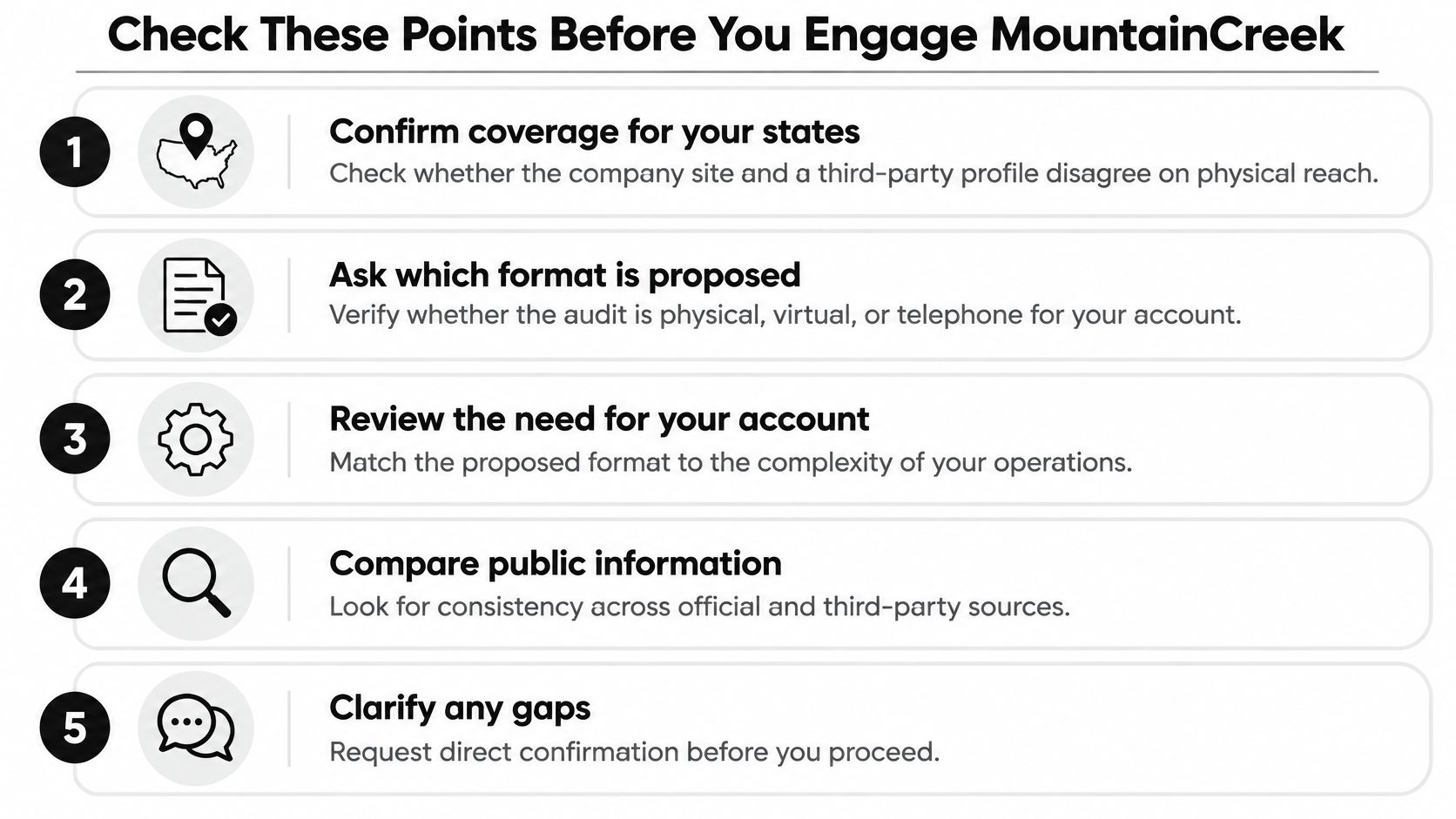
Put the scope and safeguards in writing
-
Confirm location coverage. Identify every state and business location involved, and request confirmation that the proposed service is available there. This prevents a broad coverage statement from becoming an untested assumption.
-
Approve the proposed format. Ask why the account is assigned to physical, virtual or telephone review, and what would trigger a change. The answer should address your operations, not just scheduling convenience.
-
Request quality-control procedures. Obtain an explanation of auditor qualifications, sampling and supervisor review. Named responsibilities are more useful than a general assurance of accuracy.
-
Set service expectations. Request turnaround targets, document-response deadlines and an escalation contact. Distinguish time spent waiting for your records from time spent reviewing a complete file.
-
Seek outcome evidence. Ask for relevant client references and definitions of error and rework measures. Comparable accounts are more informative than unrelated testimonials.
-
Check information handling. Confirm secure submission, access permissions, retention arrangements and conflict-of-interest controls before transferring sensitive payroll files. Don't send them to an address merely because it appears in an unsolicited message.
-
Prepare a coherent document pack. Assemble quarterly payroll summaries, job-class descriptions, operations and subcontractor lists, plus contracts or invoices showing work performed. Reconcile inconsistent labels before submission rather than expecting the auditor to infer their meaning.
-
Establish the disagreement process. Ask how to correct factual errors, submit supporting evidence and escalate disputed findings. Confirm applicable deadlines with the insurer because policy terms and jurisdiction affect the available route.
For a related example of structured service-provider questioning, Benely's Benely's guide to vetting PEOs addresses a different procurement category. Its relevance here is the discipline of obtaining specific answers, not treating PEO services as equivalent to premium auditing.
Keep the questions and replies together. A vague answer isn't proof of poor work, but it is a reason to withhold approval until the responsibility, procedure or commitment is clear.
CleanMyList offers bulk email verification with explanations for its results and a downloadable report showing what was cleaned and why. If your audit-related outreach depends on an aging contact list, visit CleanMyList to check addresses before sending, while keeping insurance and payroll documents in the approved audit channel.