Direct mail is physical promotional material such as letters, postcards and catalogs, sent through the postal system to households or businesses.
But if someone buys after receiving a postcard, how do you know the postcard caused the purchase? That's the gap between understanding what direct mail is and knowing whether it belongs in your marketing budget. A useful campaign needs more than something attractive to print. It needs a relevant audience, a worthwhile offer and a way to separate additional sales from purchases that would've happened anyway.
Table of Contents
- What Direct Mail Is and How It Reaches People
- Direct Mail Formats and Which One to Choose
- How a Direct Mail Campaign Runs From List to Mailbox
- Common Direct Mail Use Cases
- How to Measure Whether Direct Mail Pays Off
- Where Direct Mail Beats Digital and How to Decide
What Direct Mail Is and How It Reaches People
Direct mail is physical advertising sent to a defined postal audience. Think of it as a billboard you can address to a particular front door, except the recipient can keep it, pass it to someone else or use it to claim an offer.
Say a bakery wants nearby residents to try its catering service. The owner chooses a neighborhood, creates a postcard showing the catering menu, prepares the mailing and postage, then hands distribution to the postal network. Recipients don't need to visit the bakery's website or open an email to encounter the message.
The delivery model looks like this:
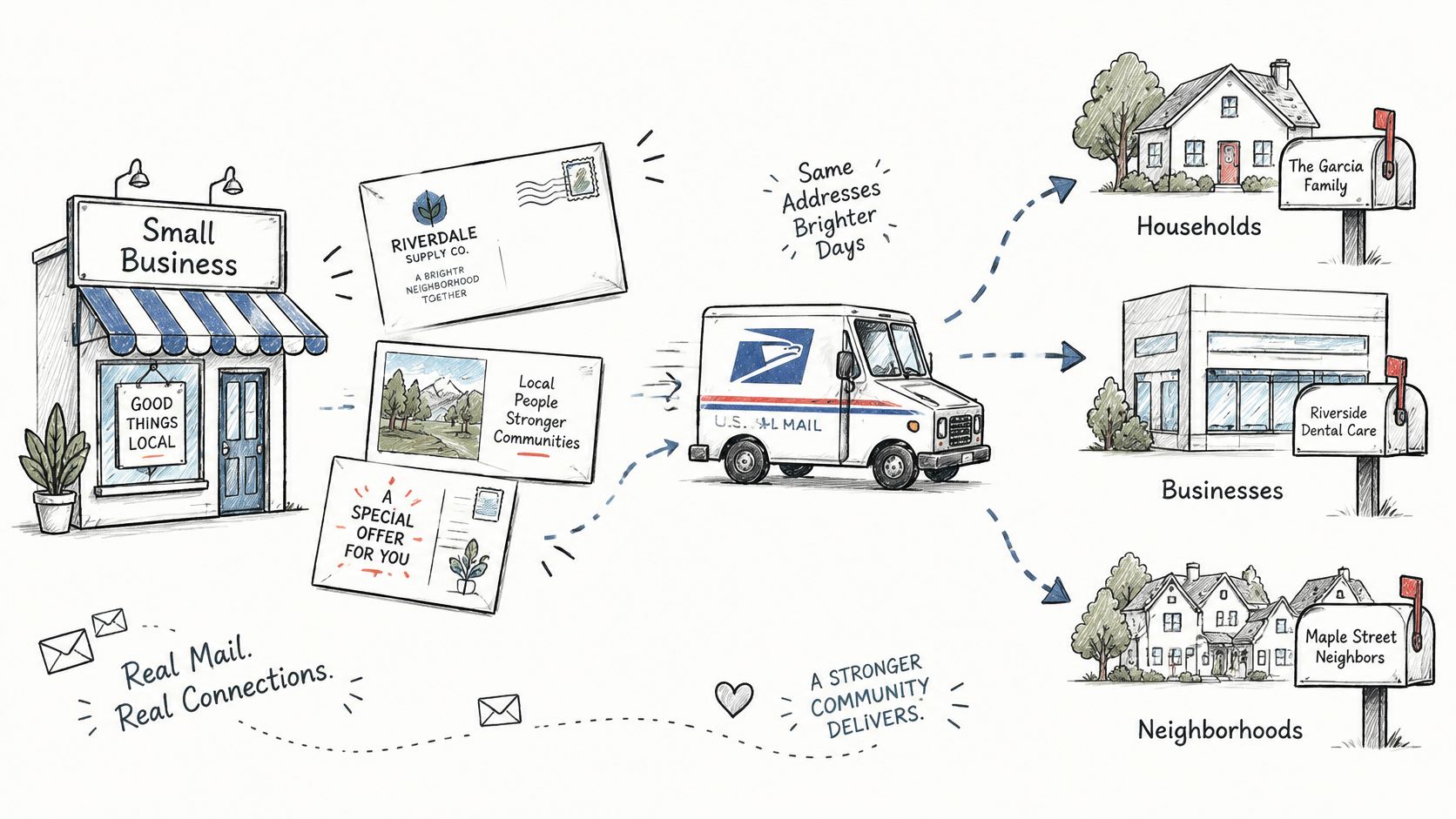
Addressed mail versus neighborhood delivery
Addressed mail goes to a specified person, household or business address. A retailer might send a catalog to existing customers, while a membership organization might mail renewal letters.
Neighborhood mail selects recipients geographically rather than by individual customer history. That can suit a bakery whose delivery area matters more than knowing each resident's name.
Common pieces include letters, postcards, catalogs, folded self-mailers and packages containing samples. The format changes, but the underlying process stays recognizable: select the audience, create the offer, prepare the mailing and arrange delivery.
This isn't merely a small-business flyer tactic. The USPS direct mail brochure reports that advertising mail represented 60% of all mail received by U.S. households in 2012, totaling 79.6 billion pieces. Those historical figures establish the channel's scale, not its current size.
Quick identification test: A printed promotion delivered through the postal system to a defined audience is direct mail. A promotional PDF or banner ad is digital marketing.
Check your own marketing mix. Customer catalogs, mailed discount cards and printed renewal appeals may already qualify, even if your team calls them something else.
Direct Mail Formats and Which One to Choose
Use this comparison to choose a format by the job it needs to do, not by how impressive it looks on a desk.
Direct mail formats at a glance
| Format | What It Looks Like | Best For | Typical Use |
|---|---|---|---|
| Letter | Addressed envelope with a letter and reply device | Personal asks and detailed offers | Donation appeals, account renewals |
| Postcard | Single card with the message visible without opening | Quick offers and local promotions | Store openings, customer reactivation |
| Catalog or booklet | Multi-page showcase of products | Browsing and high-consideration purchases | Seasonal retail, furniture, home goods |
| Self-mailer | Folded piece sealed without an envelope | Avoiding a separate envelope while showing an offer | Subscription offers, appointment reminders |
| Dimensional mailer | Box, tube or package with a sample or gift | Standing out to high-value prospects | B2B account outreach, product launches |
| EDDM (Every Door Direct Mail) | Route-based piece without individual recipient names | Local reach without a purchased list | Restaurants, local services, grand openings |
Match the space to the decision
A letter gives a nonprofit room to explain a specific need, include a signed appeal and provide a reply form. It's appropriate when the reader needs context before acting.
A postcard works better for a dental clinic reminding inactive patients to book. The clinic can make the benefit and booking method visible without asking someone to open an envelope.
A furniture retailer might choose a catalog or booklet because buyers need to compare styles and see products in context. A publisher promoting a subscription could instead use a self-mailer, with the offer outside and subscription details inside. Removing the envelope simplifies the package, though folds, paper and finishing still affect production costs.
For a software company approaching selected business accounts, a dimensional mailer might contain a relevant product demonstration or useful sample. A restaurant opening nearby would more naturally consider EDDM, where local coverage matters more than individual personalization.
Design for recognition and action
Readers should immediately recognize the sender, understand the benefit and find the next step. DesignStack's resource on building trust through marketing design is useful when reviewing how branding, hierarchy and presentation support that clarity.
Match the format to the amount of explanation the buyer needs and the value of the decision. Don't pay for a box when a card can communicate the offer.
How a Direct Mail Campaign Runs From List to Mailbox
A campaign becomes easier to manage when audience selection, production and measurement are planned together. Use this overview to see how those tasks connect.
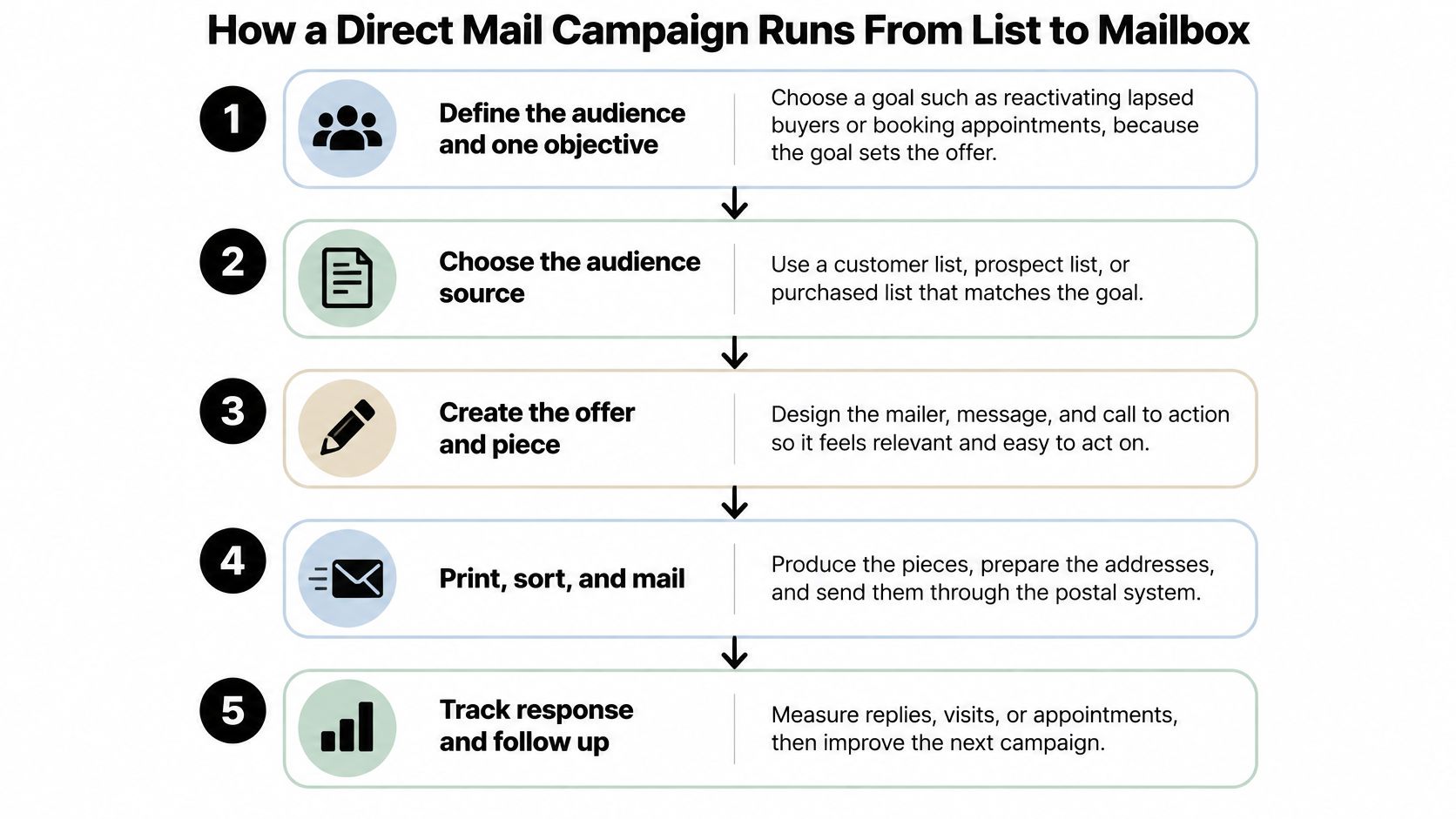
Prepare the audience and offer
-
Define the audience and objective. Choose a concrete action, such as booking an appointment or reactivating a former customer. That decision determines what the offer must accomplish.
-
Choose the audience source. Use an appropriate customer file, a carefully evaluated prospect list or a neighborhood route. If you're coordinating postal and digital outreach, our guide to email lists for marketing helps distinguish digital list-building decisions from postal audience selection.
-
Create a focused offer and response path. Ask recipients to take a clear next step, such as visiting a dedicated landing page or calling a tracked number. Assign campaign or segment identifiers before production so responses can be connected to the right audience.
Prepare the physical mailing
-
Standardize and validate postal addresses. The USPS addressing guide recommends using ZIP+4 when known and keeping apartment or suite identifiers with the street address. Preserve that information, validate postal codes and remove duplicate records before printing, because incomplete addresses can disrupt sorting or produce undeliverable returns.
-
Design, proof and print. Keep the delivery address legible, with sufficient contrast and space. Have your mailing partner confirm that the piece's dimensions, postage placement and endorsements suit the selected postal service before approving production.
The accompanying video provides another way to follow the campaign process.
Set the test before mailing
-
Choose a response window before launch. Base it on the offer's expiry and your customers' buying cycle, allowing for delivery and delayed action. Record the same outcomes during the same period for both test groups.
-
Reserve a no-mail holdout. Randomly assign eligible customers to receive the piece or receive no piece, while keeping other marketing treatment comparable. Store that assignment in your customer system before handing over the print file.
Launching without a holdout doesn't make every result useless. It does make it harder to prove that the mailing, rather than ordinary customer demand, produced the extra business.
Common Direct Mail Use Cases
Direct mail deserves consideration when the message benefits from physical presentation and the customer relationship can justify production and postage. These scenarios show the practical differences.
Situations worth testing
-
Fundraising appeals. A community nonprofit sends past donors a signed letter explaining a specific project, with a reply form and an online donation option. The personal message gives the organization room to explain what the donation supports.
-
Lapsed-customer reactivation. A gym sends former members a folded offer with a campaign-specific return code. The message acknowledges their previous membership rather than treating them like strangers.
-
Local launches. A hardware store uses a route-based mailing to introduce its location, opening offer and useful services. Geographic relevance matters more here than knowing each recipient's shopping history.
-
High-value account outreach. An accounting firm sends selected business prospects a compact package containing an industry-relevant planning checklist. The package should help the recipient evaluate a business problem, not merely deliver branded merchandise.
-
Renewals and subscriptions. A publisher mails subscribers a clear renewal offer with the subscription benefits, terms and response options. A letter can support a detailed explanation; a self-mailer can keep a simpler offer together without a separate envelope.
Situations where the economics are harder
Frequent, low-margin purchases are a weaker starting point. If you're promoting inexpensive replenishment items to existing subscribers, email may let you communicate more quickly without paying to manufacture and deliver each message.
That alternative still requires an appropriate relationship with recipients. Our guide to permission-based email marketing explains how to approach that digital audience responsibly.
Choose a use case based on customer value, contribution margin and the action you want, not whether a mailing could attract attention. An attractive package that generates unprofitable orders isn't a successful acquisition channel.
How to Measure Whether Direct Mail Pays Off
Start with response rate and cost per piece, then move toward the measure that matters most: what you spent to generate business you wouldn't otherwise have received.
Simple direct mail ROI metrics
| Metric | Formula | What It Tells You |
|---|---|---|
| Response rate | Responses ÷ pieces mailed | How many recipients acted |
| Cost per piece | Total campaign cost ÷ pieces mailed | Baseline spend per contact |
| Cost per response | Total campaign cost ÷ responses | Efficiency of the offer |
| Revenue per thousand pieces | Attributed revenue ÷ pieces mailed × 1,000 | Comparison across campaigns and formats |
| Cost per incremental order | Total cost ÷ (mailed-group orders − holdout orders scaled to group size) | Cost of additional orders attributable to mail |
| ROI | (Incremental revenue − total cost) ÷ total cost | Revenue-based return before product costs |
Include creative, data preparation, printing, postage and other campaign expenses in total cost. Define “response” in advance, because a QR scan, inquiry and completed purchase aren't interchangeable.
Calculate lift before celebrating sales
For a hypothetical example, suppose you mail 10,000 pieces for $6,000 and observe 120 orders, while an equally sized, comparable holdout produces 30 orders without mail. The estimated incremental result is 90 orders, making cost per incremental order approximately $67.
In that same hypothetical scenario, assume an average order value of $100. Incremental revenue would be $9,000, and the revenue-based ROI calculation would be ($9,000 − $6,000) ÷ $6,000 = 50%.
That isn't necessarily a profit. Product costs, fulfillment, returns and discounts still need to be covered, so compare acquisition cost with contribution margin, not revenue alone. Silva Marketing's explanation can help you compare ad spend return benchmarks, while keeping revenue return distinct from profitability.
Account for mixed-channel behavior
Physical delivery doesn't mean the customer journey stays offline. The USPS Informed Delivery year review reports 45 billion mailpiece and package impressions during April 2024 through March 2025, illustrating how postal experiences can include digital previews.
Several household members may see a piece. Customers may buy later, visit a store without using a code or encounter email and social ads before ordering.
Measurement rule: A code identifies a response path. A well-designed holdout estimates whether the mailing added business.
Use customer-record matching alongside codes and tracked URLs. For route campaigns, consider comparable test and control areas, recognizing that neighborhood differences can weaken the comparison. Keep other marketing exposure consistent where possible, and scale holdout results to the mailed group's size before calculating lift.
Where Direct Mail Beats Digital and How to Decide
Direct mail isn't automatically better than digital. It offers a different way to reach someone, with different production requirements and economics.
Use this comparison as a planning guide, not a universal performance ranking.
Direct mail compared with email and paid social
| Factor | Direct Mail | Paid Social | |
|---|---|---|---|
| Attention in a crowded channel | Physical piece can stand apart from screen-based messages | Can be skipped among inbox messages | Competes with feed content and other ads |
| Speed to launch | Requires production and postal delivery | Can launch after audience and message approval | Requires creative setup and platform approval |
| Cost per contact | Includes printing, postage and data preparation | No physical production or postage | Set by bidding, audience and campaign settings |
| Targeting | Named addresses, routes and customer files | Subscriber and behavior data | Platform audience targeting |
| Measurement | Codes, personalized URLs, record matching and holdouts | Clicks and conversions, with attribution limits | Platform reporting, with attribution limits |
| Frequent, low-margin purchases | Often difficult to justify | Practical starting point for subscribed customers | Test against acquisition margin |
| High-value or lapsed-customer journeys | Worth a controlled test | Useful for relationship-based follow-up | Useful for reaching or retargeting eligible audiences |
What the channel comparison actually tells us
A 2025 peer-reviewed study comparing direct mail and email found direct mail more effective for nonprofit donation appeals, but no comparable advantage for for-profit purchases. The authors linked the effect to perceptions of resource efficiency and sustainability; sustainability-focused nonprofits received no special benefit.
That distinction matters. A physical appeal may suit a charitable request without making a printed retail promotion superior to email.
Don't use memorability as a substitute for sales evidence. If the audience sees paper, packaging or delivery as wasteful, explain the practical value of the piece and choose materials thoughtfully rather than assuming physical presentation builds trust.
Make the decision testable
Before approving production, answer these questions:
- Economics: Can the expected customer contribution cover the full acquisition cost?
- Address quality: Are the postal records complete and current?
- Tracking: Can you connect orders or qualified inquiries to customer records?
- Control: Can you keep a comparable audience out of the mailing?
- Environmental fit: Is printed outreach consistent with your audience's expectations?
For a first test, narrow the audience and format so you can interpret the result. Set your acceptable cost per incremental order in advance, then expand only if the observed contribution supports it. The principles behind measurable marketing with Data Hunters Agency provide useful context for connecting an offer to an observable action.
When email is the better fit, use relevant segmentation rather than sending the same message indiscriminately. Our guide to targeted email marketing explains that approach.
Before spending on either channel, deduplicate customer records and suppress inappropriate contacts. Validate postal and email addresses separately, because a valid mailbox in one channel says nothing about deliverability in the other.
CleanMyList helps you verify the email side of a coordinated campaign so questionable addresses stay out of your next send; it doesn't validate postal addresses. Visit CleanMyList to clean 50 emails at no cost, with no credit card and no sales call required, before launching your digital follow-up.