A valid address isn't necessarily a good address to send. It may accept mail and still belong to an inactive subscriber, a shared role inbox, or a catch-all domain where mailbox-level certainty is limited. Treating every validation result as a simple keep-or-delete instruction can remove reachable people without improving campaign outcomes.
That distinction should shape how you assess ZeroBounce email validation and its alternatives. Compare not only a vendor's accuracy claim, but also what its checks can establish, how it handles uncertainty, whether its method fits your privacy requirements, and how you'll act on each verdict.
Table of Contents
- Why a Validation Verdict Is Not the Same as a Clean Send
- ZeroBounce at a Glance, Features, Scale, and Caveats
- Signals Checked and the No-Send Verification Approach
- Side-by-Side Comparison of ZeroBounce and Top Alternatives
- Pricing Models and the Real Cost of Email Verification
- Stopping Bad Data at Signup With Real-Time Validation
- Best Fit by Use Case, From Newsletters to Outbound Sales
- Decision Framework and When to Layer Tools
Why a Validation Verdict Is Not the Same as a Clean Send
“Valid” answers a narrow question about an address. It doesn't promise inbox placement, engagement, or revenue. A mailbox can exist while its owner ignores your messages, and an address that passes a technical check can still be risky because it's a catch-all, a role account, or an old contact with no recent engagement.
That gap matters to marketers working on deliverability. The 2024 deliverability research cited in this analysis reports that 48% of senders identify staying out of spam as a top challenge, while only 23.6% verify lists before every campaign; roughly 40% rarely or never perform list hygiene (Mailgun's State of Email report). These figures point to a process problem, not proof that every unverified address is harmful or that every verified one is safe.
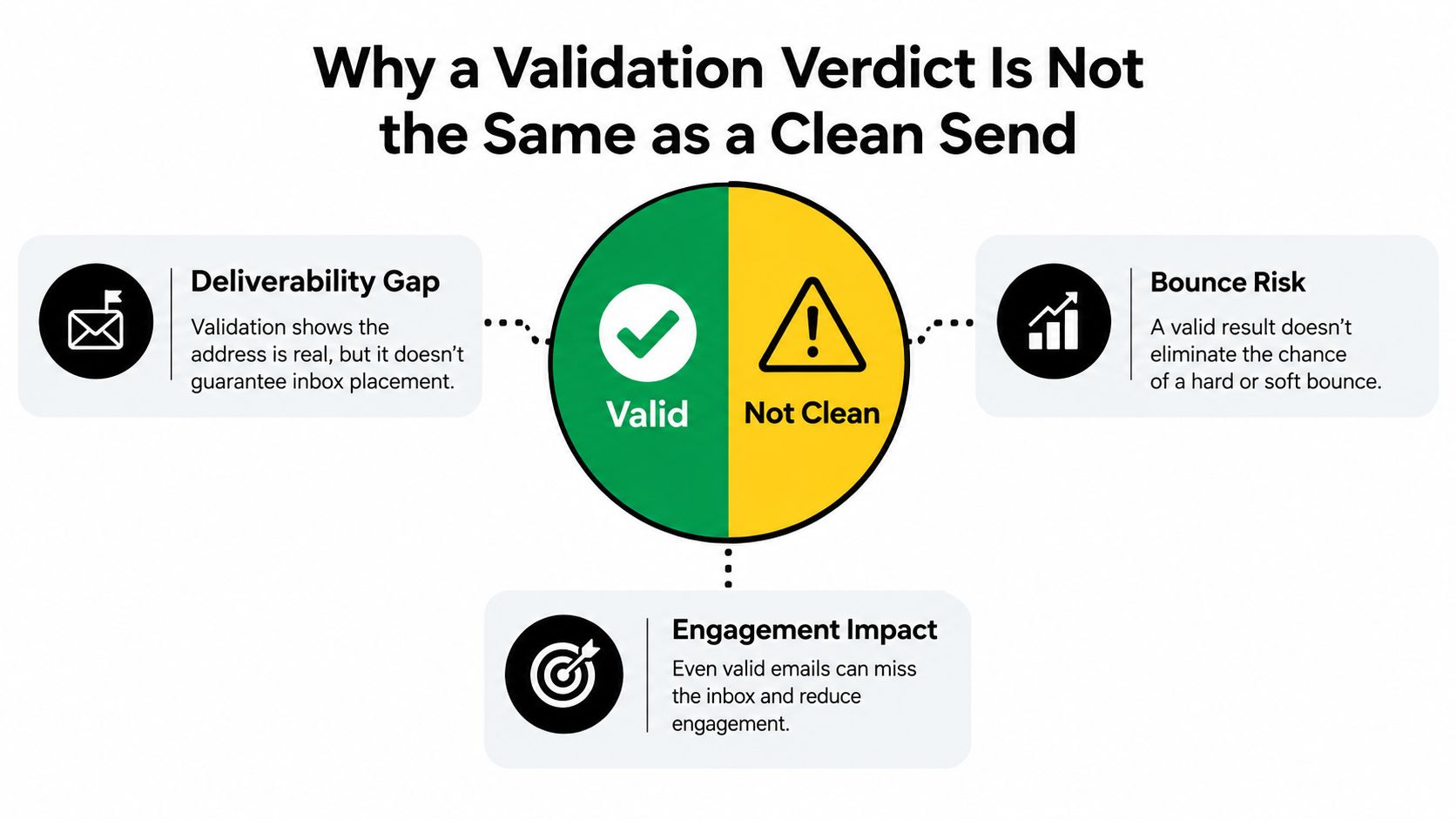
The practical alternative to a binary rule is to make the verdict one input into a sending decision. A hard failure may warrant suppression; a suspected typo may deserve a correction prompt; a catch-all result may call for cautious segmentation or review. Dormant subscribers need an engagement policy, not just an address check.
The useful question isn't only “Is this address valid?” It's “What should we do with this result, given how the contact was acquired and how they've behaved?”
That's also why a headline accuracy number can't settle the vendor comparison. Marketers should look at how a provider defines its test set, distinguishes errors from unresolved results, and returns reason codes that support different actions. For a practical explanation of how validation labels can inform decisions, see what email validation verdicts mean.
ZeroBounce at a Glance, Features, Scale, and Caveats
ZeroBounce's public figures describe a service operating internationally and at substantial processing scale. Public reporting cited more than 325,000 corporate customers by July 2024, while later company materials claimed more than 650,000 customers across over 200 countries and territories. The company has also stated that it validated more than 30 billion email addresses, while another description referenced over 60 billion processed emails or validation-related records (company history and figures).
Those figures come from different dates and descriptions. They aren't a single audited time series, so they shouldn't be added together or used as a clean growth comparison. They do suggest that demand for validation extends beyond one national market, and that even a small classification error can matter when a system processes lists at scale. ZeroBounce's product expansion into domain warming, blacklist monitoring, DMARC monitoring, server testing, and inbox-placement testing also shows how the company positions validation alongside broader sender-reputation work.

How to read the published benchmark
ZeroBounce's July 2026 benchmark tested 9,901 addresses drawn from difficult-to-validate pools, including security-gateway-protected business domains, catch-all-heavy environments, major consumer providers, malformed addresses, duplicates, and special formats (ZeroBounce's benchmark). It reported 98.02% accuracy, alongside 1.38% inaccurate classifications, 0.60% unresolved catch-all results, and 0% unknown results.
The sub-rates matter because a wrong verdict differs from a result the system can't resolve. The benchmark reports those categories separately, which helps readers ask more specific questions about how a vendor handles uncertainty. But the benchmark was conducted by ZeroBounce itself. Without independent ground-truth verification, its results are useful for understanding the company's own test and reporting, not as independent proof that it outperforms competitors.
Compare benchmark claims by checking the test corpus, the source of ground truth, how catch-all domains are categorized, and how unknown or unverifiable results are counted. A single accuracy headline hides these choices.
Signals Checked and the No-Send Verification Approach
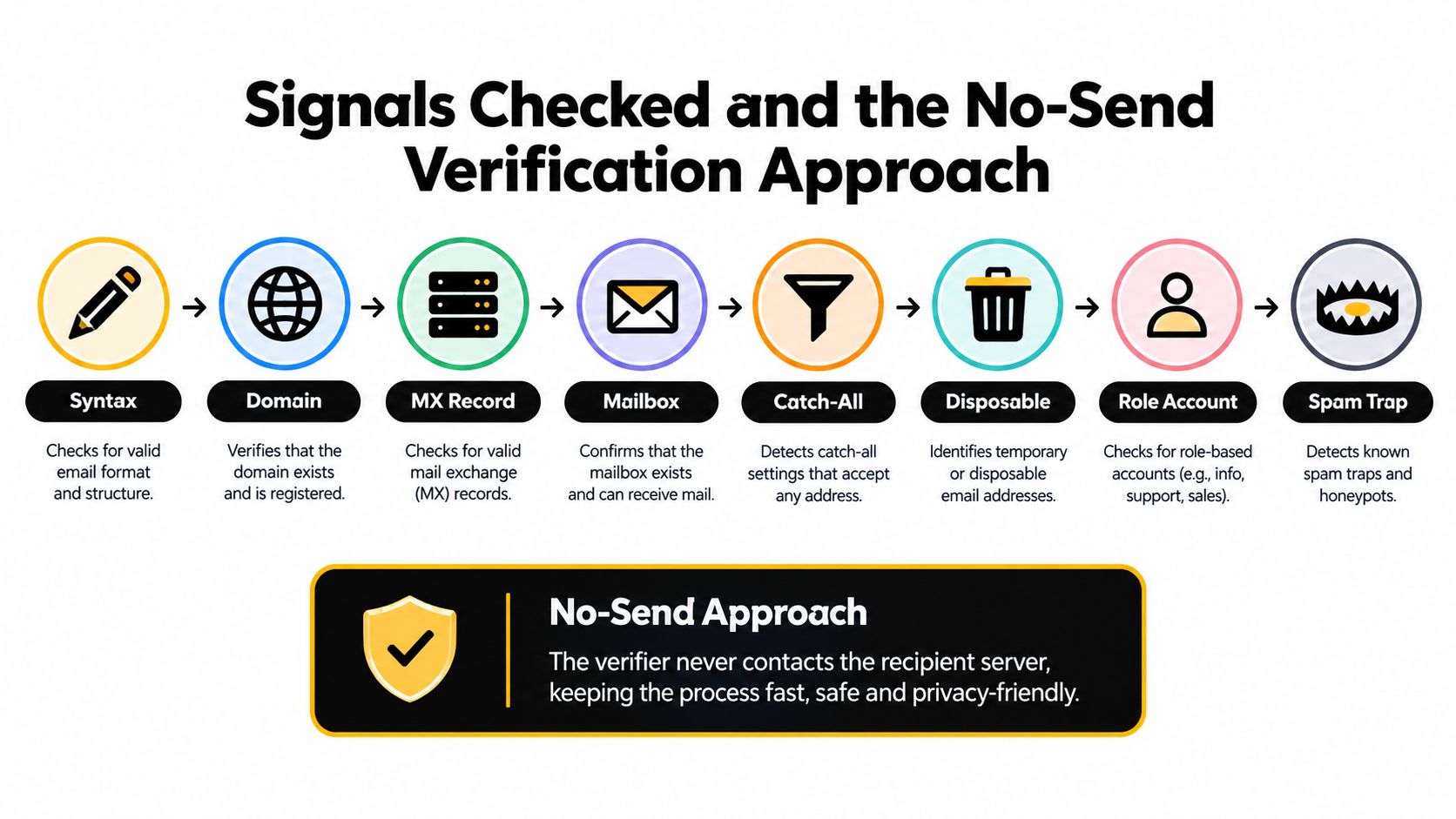
A verifier's recommendation depends on the signals it checks and the method it uses to check them. A no-send workflow can combine format and domain checks with mailbox-related indicators and risk flags, then return a recommendation rather than treating every record as valid or invalid.
A useful eight-signal model includes:
- Syntax: Does the address follow accepted formatting rules?
- DNS and MX lookup: Does the domain appear to have mail-handling infrastructure?
- SMTP mailbox-existence probing: Can the verifier assess whether the mailbox appears to exist without sending an email?
- Catch-all behaviour: Does the domain accept mail broadly, making individual mailbox confirmation difficult?
- Disposable-provider recognition: Does the address use a temporary email service?
- Role-account flagging: Does it appear to be a shared inbox such as a general department address?
- Historical bounce reputation: Is there an available bounce-risk signal associated with the address?
- Send-or-skip recommendation: What action does the combined evidence support, and why?
Method changes the trade-off
ZeroBounce's API documentation exposes several fields beyond a binary result. Its response can include status and sub-status, typo suggestions, free-provider classification, account and domain components, domain age, SMTP provider, catch-all status, and MX indicators. Optional enrichment fields can include name and location data. The documented API supports real-time single-address validation, and its Go client documents bulk-validation options and phase-specific file retrieval (ZeroBounce Go client and API schema).
These fields can support a more deliberate workflow: suggest a correction for a likely typo, review catch-all addresses separately, and avoid treating an unknown result as an automatic rejection. The API documentation also advises practical safeguards for signup flows, including timeouts, fallback behaviour, storing verdicts with reason codes, and applying a business-specific policy to uncertain results.
A no-send approach, as described by CleanMyList, avoids sending test messages during validation and is intended to support privacy-conscious checks. SMTP probing can provide another layer of mailbox-related evidence, but vendors may differ in how they perform checks, interpret responses, and manage data. Ask each provider directly about its verification method, retention period, encryption, and handling of data sent to its API.
A verification result is a risk signal, not consent to contact and not a promise of inbox delivery.
Side-by-Side Comparison of ZeroBounce and Top Alternatives
A useful comparison separates documented facts from details that need confirmation. The available verified information gives a relatively detailed view of ZeroBounce's benchmark and API, and CleanMyList's stated no-send approach and checking signals. It doesn't establish independent accuracy figures, privacy terms, or complete current pricing for every vendor below, so those fields shouldn't be filled with assumptions. Before choosing, confirm the details in each provider's current documentation and contract.
| Vendor | Verification method | Signals checked | Pricing model | Privacy stance |
|---|---|---|---|---|
| ZeroBounce | API documentation describes SMTP-provider and mailbox-related indicators; ask the vendor about its exact probing process | Status, sub-status, typo suggestions, free-provider flag, domain and account components, catch-all and MX indicators; optional enrichment | Confirm current credit and subscription options with the vendor | Review current retention, encryption, and data-processing terms |
| CleanMyList | No-send verification, as described by the publisher | Syntax, DNS, SMTP mailbox-existence indicator, catch-all, disposable, role account, bounce reputation, send-or-skip recommendation | Credit bundles; publisher states credits don't expire | Publisher states it doesn't send messages during checks, encrypts data, and deletes lists after 30 days |
| NeverBounce | Confirm the current verification method with the vendor | Request the current signal and result definitions | Confirm available plan and billing options | Review current retention and security documentation |
| Hunter Verifier | Confirm the current verification method with the vendor | Request the current signal and result definitions | Confirm available plan and billing options | Review current retention and security documentation |
| Kickbox | Confirm the current verification method with the vendor | Request the current signal and result definitions | Confirm available plan and billing options | Review current retention and security documentation |
Match the tool to the decision
ZeroBounce is a candidate for teams that want validation alongside a broader set of sender-reputation services and API response fields. Its benchmark should be assessed as a vendor-reported result, with close attention to the test pool and unresolved classifications rather than the headline alone.
CleanMyList is positioned for teams seeking bulk checks and signup validation without sending verification emails. Its stated signals and send-or-skip recommendation are relevant when a marketer needs reasoned handling for borderline records, but its performance should still be tested against the team's own data and requirements.
NeverBounce, Hunter Verifier, and Kickbox belong in a shortlist only after confirming their present-day method, result categories, API capabilities, and privacy terms. A vendor directory can help identify other candidates, but use it as a starting point, then validate claims against each provider's own documentation. Grou's guide to finding reliable email checking tools offers another place to begin that shortlist.
Pricing Models and the Real Cost of Email Verification
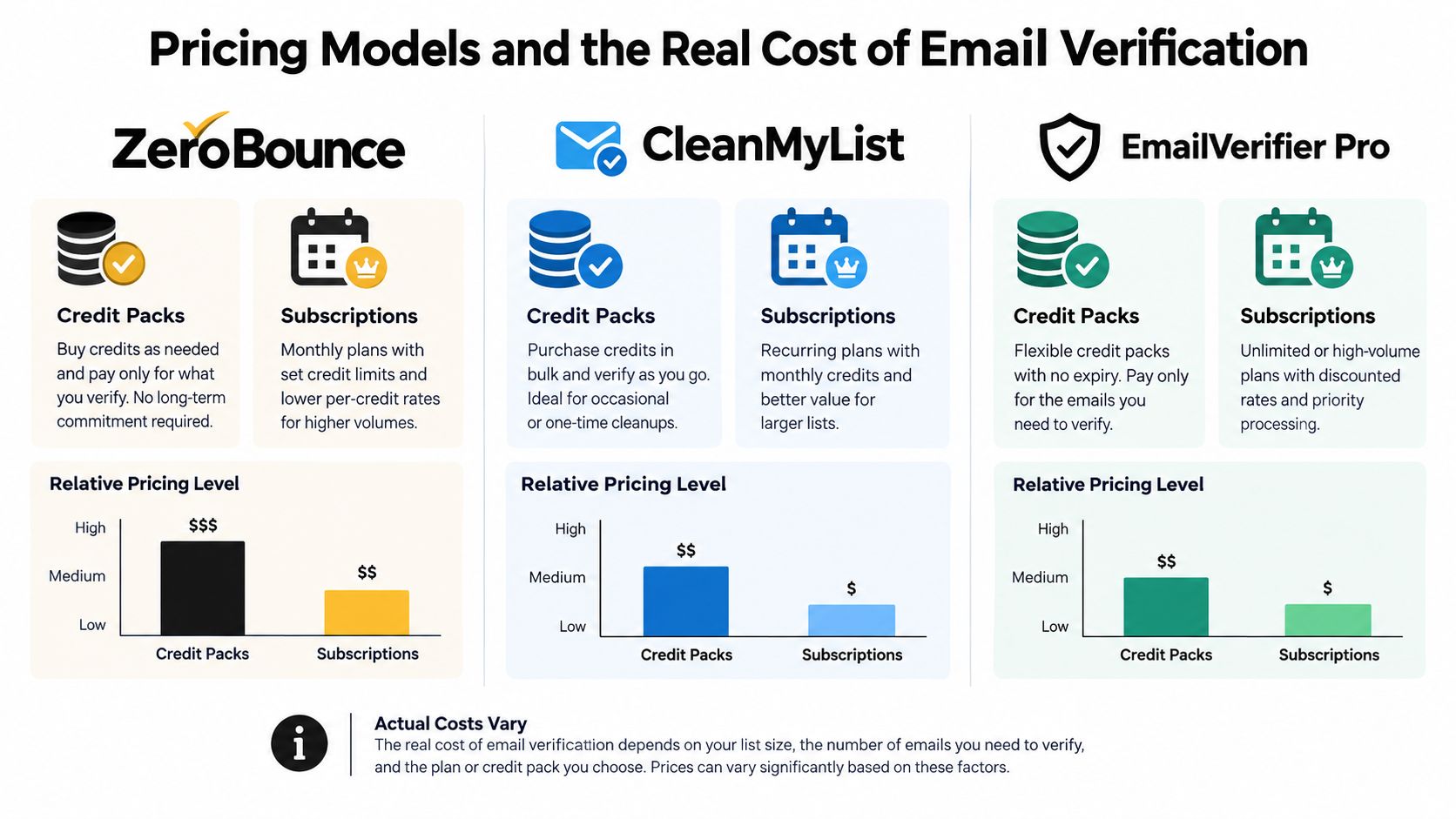
A low per-credit price doesn't automatically mean a low annual cost. The right comparison depends on how often your team cleans lists, whether credits expire, whether real-time checks are billed separately, and how much work falls on staff when results need interpretation.
The available product information supports a limited but practical comparison. CleanMyList describes a no-subscription model with credit bundles that don't expire, bundles starting at $6, and 50 free credits for a new account, as stated by the publisher. ZeroBounce has been described as offering validation at scale, but the verified material here doesn't establish its current price schedule. Treat subscription tiers, credit packs, and API billing as items to confirm directly rather than relying on outdated comparisons.
Calculate total cost, not a single upload
Before buying, map the expected usage pattern. A publisher that cleans a list occasionally has different needs from an ecommerce team that checks every signup. A monthly subscription can suit predictable usage, while pay-as-you-go credits may fit irregular campaigns. The trade-off depends on whether credits expire, whether the plan has minimum commitments, and whether bulk and real-time validation draw from the same balance.
Check these costs in writing:
- Credit expiry and minimums: Find out what happens to unused credits and whether a plan requires ongoing spend.
- API and bulk charges: Ask whether signup checks and file uploads share the same rates or have separate billing.
- Overages: Confirm what happens when usage exceeds the included balance.
- Rechecks: Include periodic checks of older records in your forecast, since address status can change over time.
- Operational work: Account for the time your team spends reviewing catch-all, unknown, or otherwise uncertain results.
For current bundle details, review CleanMyList's pricing information. Then compare it with written quotes from shortlisted providers using the same list size, check frequency, and API requirements. That gives you a more meaningful estimate than comparing advertised entry prices alone.
Stopping Bad Data at Signup With Real-Time Validation
Cleaning an old list is reactive. Signup-time validation can catch a typo or suspicious address before it becomes a CRM record, triggers a welcome email, or inflates acquisition reporting. A cited deliverability report says approximately 9% of addresses entered through web forms are invalid, while around 28% of senders use automated email validation and fewer than 40% use double opt-in (Kickbox's email deliverability report). These figures describe a potential capture-quality gap, not a guarantee that any particular form has the same error rate.
Real-time validation works best when it produces graduated outcomes. A strict pass-or-fail gate can block legitimate users, especially when an address is shared, associated with a role, or hosted on a catch-all domain. Instead, connect the result to a policy that reflects the purpose of the form.
Give each outcome a job
- Accept: Allow a normal-looking address with no material warning to continue.
- Challenge: If the system detects a likely typo, show a correction suggestion or ask the user to confirm the address.
- Quarantine: Hold uncertain cases, such as catch-all or unresolved results, for review or a confirmation step rather than discarding them.
- Reject: Block a clearly malformed or policy-prohibited address, and explain what the user can do next.
The implementation matters as much as the verdict. Call the validation service from the signup flow, set a timeout, and provide a fallback so a temporary API issue doesn't erase a valid registration. Store the status and reason code with the contact record, then pass those fields into your CRM and analytics so acquisition teams can distinguish confirmed contacts from unresolved ones.
For an API workflow, plan for both the normal response and the failure path: preserve the form submission, prevent duplicate records, and avoid treating an unavailable check as proof that an address is invalid. A concise overview of real-time email validation API use can help teams assess where signup checks belong in their application stack.
Best Fit by Use Case, From Newsletters to Outbound Sales
A vendor that suits a large one-off cleanup may not be the right choice for a signup form or a sales team's lead workflow. Choose based on the kind of decision you need to make, then test how the service classifies real examples from your own data.
| Team and use case | Practical fit | Trade-off to accept |
|---|---|---|
| Newsletter creators and publishers cleaning a large legacy file | Compare bulk workflows and reason codes across ZeroBounce and other shortlisted vendors | A valid address still needs an engagement and suppression policy |
| Ecommerce and DTC teams running reactivation campaigns | Pair list checks with recency, engagement, and suppression rules | Removing every uncertain address may discard reachable customers without proving improved campaign value |
| Outbound sales teams validating contact data | Compare the provider's method, catch-all handling, and policy for shared business inboxes | A reachable mailbox doesn't establish permission, relevance, or prospect intent |
| Developers validating new signups | Choose an API or widget that returns actionable statuses and has a clear timeout and fallback path | Real-time checks add a dependency that the form must handle gracefully |
For newsletters and publishers, bulk validation can help flag risky records before an infrequent send, but it shouldn't replace engagement-based suppression. Ecommerce teams should be especially cautious about deleting borderline contacts from reactivation audiences without considering purchase and interaction history.
Outbound sales teams need to distinguish an address that may accept mail from a contact who is appropriate to email. Developers should prioritise usable API responses, clear reason codes, and failure handling over a headline accuracy figure. Some organisations may find that one tool handles signup checks while another suits periodic audits, but that choice should follow a privacy and workflow review rather than a desire to add vendors.
Decision Framework and When to Layer Tools
Use a four-part decision process:
- Define the job: Are you checking a legacy list, preventing bad form entries, or assessing sender reputation?
- Choose the method: Decide whether mailbox probing or a no-send approach better fits your privacy and operational requirements.
- Set tiered actions: Accept, challenge, quarantine, or reject based on the verdict and the contact's context.
- Recheck aged data: Review older files when campaign risk warrants it, and combine validation with engagement-based suppression.
Layer tools when their roles are distinct, such as using signup-time checks to improve data capture and periodic bulk audits to review older records. Don't let either process stand in for consent management, authentication practices such as DMARC and DKIM, or a clear policy for disengaged contacts.
CleanMyList offers bulk CSV and pasted-list verification, real-time signup validation, and reasoned send-or-skip results without sending verification emails. Review its validation options and decide whether its no-subscription workflow fits your team's privacy, data-capture, and campaign needs.