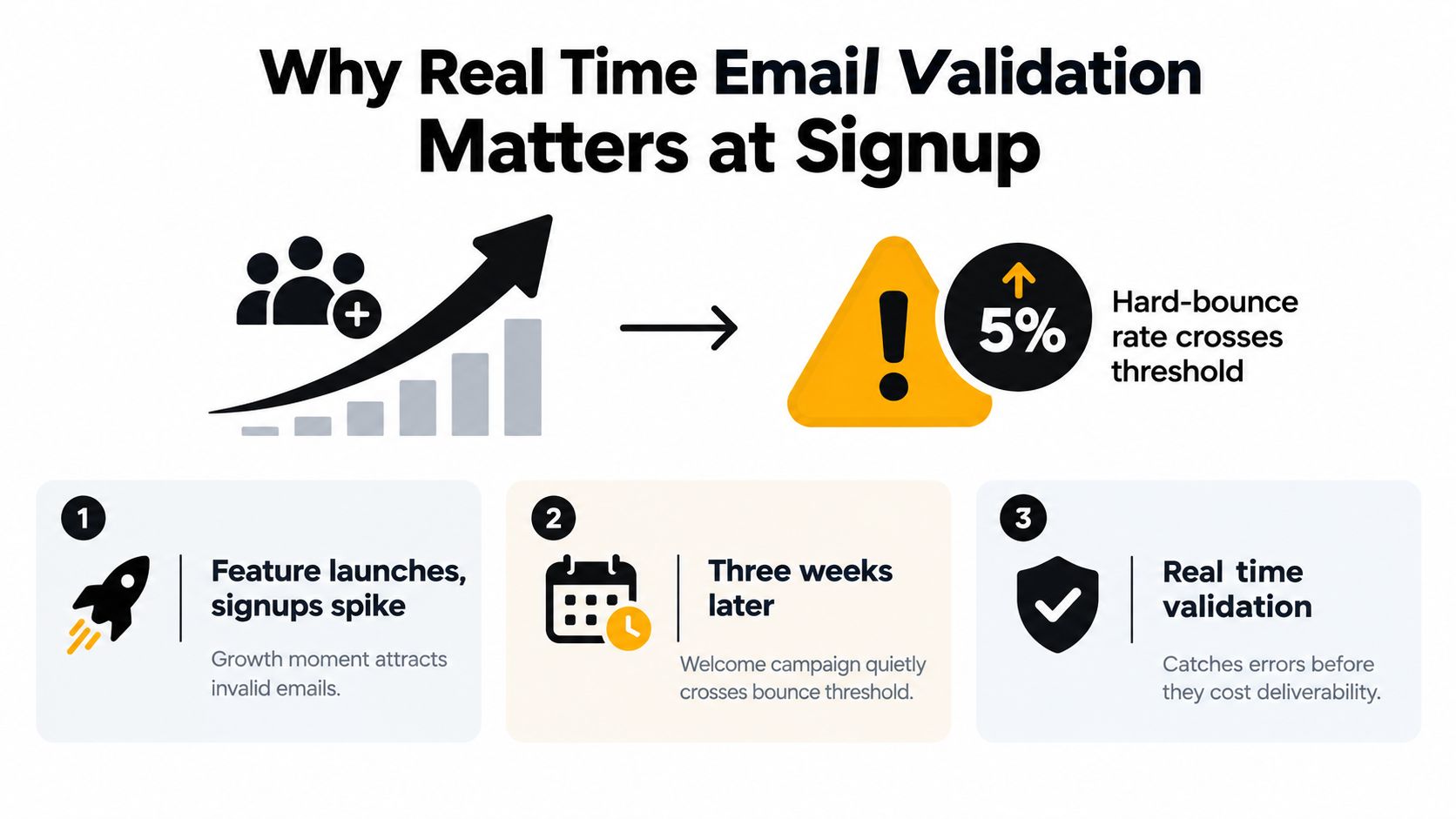
You ship the launch, watch signups climb through the afternoon, and feel good about the numbers until the welcome campaign goes out a few weeks later. Hard bounces spike, your sending domain gets throttled, and the CRM is now full of addresses nobody can fix because the people who typed them left long ago. That's the gap a real time email validation API fills, not as a stricter regex, but as a graded risk check at capture and again before you send.
Table of Contents
- Why Real Time Email Validation Matters at Signup
- The Anatomy of a Real Time Validation Pipeline
- Endpoint Contract, Request and Response Examples
- Designing the Signup UX Around Debounce
- Choosing Between Native Libraries and a Drop-In Widget
- Why SMTP Acceptance Is Not Deliverability
- Error Handling, Retries, and Privacy Basics
Why Real Time Email Validation Matters at Signup
You drop a validation snippet into the signup form, mostly to stop obvious garbage, and the first production failure isn't obvious at all. It's a one-character domain typo. The address looks right, passes your pattern check, creates an account, and then bounces hard on the first welcome email. The user never confirms, never activates, and never sees a correction prompt because the moment when they could've fixed it passed in a second.
That failure mode shows up at a scale that surprises teams who haven't measured form data. In a dataset of more than 500,000 addresses collected through online forms, 22% were incorrect or invalid, split between 15% typos and 7% abandoned or inactive addresses in that same dataset. Run those rates against 10,000 new submissions and you're looking at roughly 2,200 records needing correction, suppression, or later re-engagement work.
Why Batch Cleanup Cannot Recover the Signup
Batch cleanup helps before a campaign, but it can't rewind a signup. By the time a weekly hygiene job flags a typo domain, you've already sent the confirmation to nowhere, logged a bounce, and lost the only session where the user was present to correct themselves. Your support team also inherits a record that looks like a churned user when it's really a data entry error.
Real time validation changes where the control sits. Instead of validating text long after entry, you return an operational verdict while the form is still open, covering structure, mail routing, and risk signals. That same verdict then travels with the record into your CRM, so downstream automation doesn't have to guess why an address was accepted.
What Good Capture Time Validation Buys You
- Fewer permanent bad records: The user fixes a typo domain in the field, not through a support ticket days later.
- Lower bounce exposure on first send: Fabricated and unroutable addresses never reach your welcome flow.
- Cleaner lifecycle data: Activation rates reflect product interest, not the share of forms filled in on a phone keyboard.
- A policy lever, not just a gate: You can block hard failures, warn on risky ones, and let uncertain ones through with a flag.
The practical shift is treating validation as part of signup design. A form that catches a plausible typo in the moment protects deliverability and conversion at the same time, because the fix costs the user one keystroke instead of a lost account.
The Anatomy of a Real Time Validation Pipeline
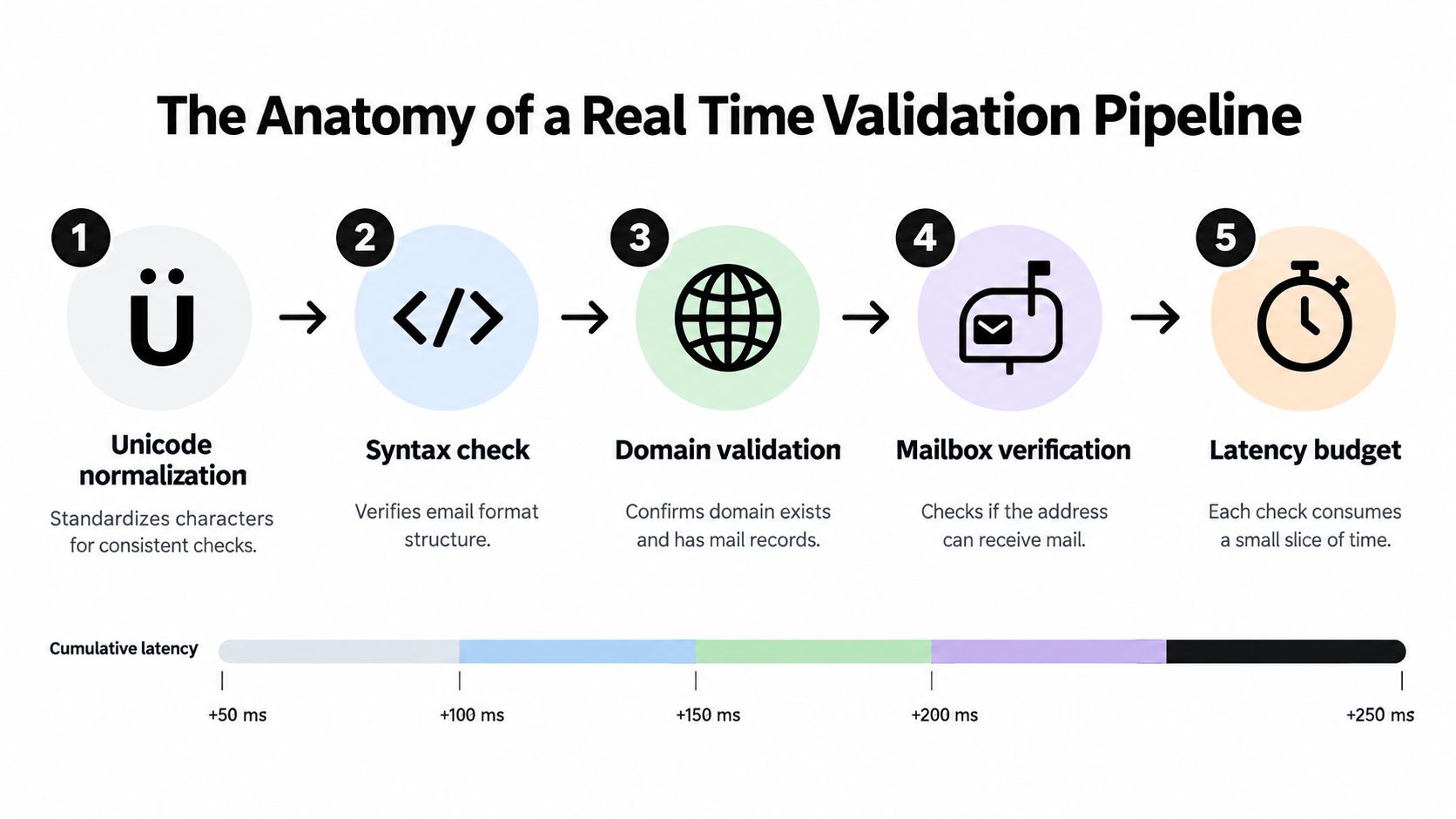
A production pipeline runs checks in order, cheapest first, and stops early when it already has a decisive answer. That ordering isn't cosmetic. Each later step costs more time, touches the network, or depends on a third-party server deciding how much it wants to reveal.
The sequence described in the detailed breakdown of email validation rules and limits starts with normalization, then parsing, then DNS, and only then an SMTP probe. If a vendor can't explain that order, or skips straight to claiming SMTP accuracy, you're probably buying a regex wrapper. A guide to what an email pattern regex can and cannot catch is a useful baseline for spotting that difference.
The Ordered Checks
- Normalize Unicode and whitespace: Trim stray spaces and standardize characters so the same address doesn't validate differently based on encoding.
- Parse against RFC 5322 grammar: Check the address structure itself. This standard traces back to RFC 822 in 1982 and was revised as RFC 5322 in 2008, while SMTP moved from RFC 821 in 1982 to RFC 5321 in 2008.
- Enforce SMTP path constraints: Reject paths beyond the 256 octet limit before you spend a network call on them.
- Resolve mail routing: Look for MX records, falling back to the domain's A or AAAA record when no MX exists.
- Probe SMTP last: Attempt a capability or mailbox-level check only after cheaper signals pass.
Non-ASCII addresses need explicit SMTPUTF8 handling in that flow. Applying ASCII-only rules rejects legitimate internationalized mailboxes, which is a quiet way to lock out real users in markets where those addresses are normal.
Why the Response Needs More Than a Boolean
A real-time call can't wait indefinitely for a slow DNS answer or a server that greylists first contact. Your latency budget is bounded by a human staring at a form, so the API has to return something useful when it runs out of time or information.
That's why distinct states matter, such as invalid_syntax, no_mail_route, timeout, blocked_probe, accept, and unknown. Collapsing a timeout into invalid tells your form to reject a person because a network hiccuped. Collapsing a blocked probe into accept tells your sender to trust an answer you never received. Keep the states separate and your integration can make sensible trade-offs later.
Endpoint Contract, Request and Response Examples
Design the contract as if three different consumers will read it, because they will. Your form needs an immediate behavior, your backend needs a stored verdict, and your analytics need a reason code that still makes sense in six months. A single true or false field serves none of them well.
A minimal synchronous endpoint takes one address per call for signup use, authenticated with your API key, and returns a structured object rather than an error string. Batch endpoints belong in a separate job flow for list work, not bolted onto the same contract, because their latency and failure modes are completely different.
Fields Your Integration Will Actually Consume
| Field | What it tells you | Typical form behavior |
|---|---|---|
| verdict | Graded outcome such as send, review, or skip | Drives block, warn, or accept logic |
| reason | Plain explanation tied to a stable code | Renders inline help text |
| confidence | Strength of the combined evidence | Separates strong accepts from guesses |
| is_catch_all | Domain accepts arbitrary recipients | Soft warn, flag for review |
| is_role_account | Address looks like a shared function mailbox | Accept or warn by use case |
| is_disposable | Domain belongs to a throwaway provider | Warn, or block for paid trials |
| provider | Detected receiving provider where available | Helps debug provider-specific behavior |
A clean accept should read as a high-confidence send verdict with a routable domain and no risk flags raised. A hard reject should carry a specific reason, such as invalid syntax or no mail route, so the UI can say something more helpful than a generic error. The interesting case sits between them, an inconclusive result where the domain routes mail but mailbox existence couldn't be established.
Mapping Verdicts to Form Behavior
- Hard reject: Block submission and show the specific reason next to the field, with a suggested correction when the domain looks like a near miss.
- Disposable flagged: Warn clearly if your product requires a durable address, since password resets will fail later.
- Catch-all flagged: Let the signup proceed, store the flag, and treat first-send engagement as the main signal.
- Unknown or timeout: Accept the address, log the state, and queue a background recheck instead of punishing the user.
Practical rule: Only a hard, evidence-backed failure should stop a signup. Everything uncertain gets accepted, flagged, and resolved later where a wrong decision costs less.
Store the full response object, not just the verdict. When a deliverability question surfaces months later, you'll want to know whether that record was a confident accept or an unknown you deliberately let through.
Designing the Signup UX Around Debounce
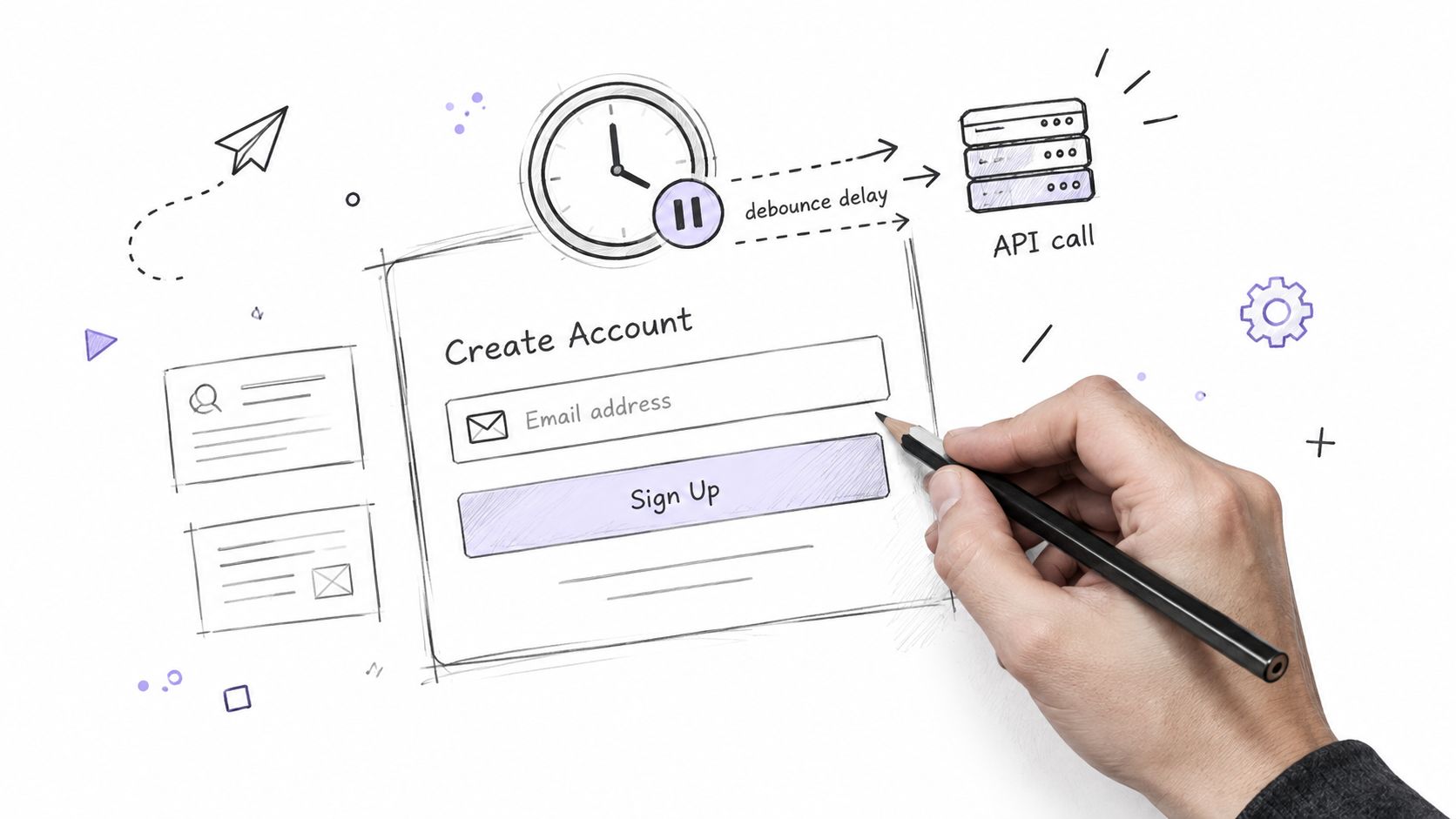
A user mid-typing doesn't have an invalid email address. They have an unfinished one. Fire a validation call on every keystroke and you'll burn quota, race your own responses, and flash error states at people who haven't reached the domain yet.
Debounce solves the timing, but the delay itself is a design decision. Wait too briefly and you validate fragments. Wait too long and the user tabs to the password field, submits, and meets an error they could've seen earlier in context. Pair the pause after typing stops with a second trigger on blur, so fast tabbers still get checked before submit.
Inline States Without Modal Drama
Render validation as an inline state attached to the field. Idle shows nothing, checking shows a subtle spinner or muted text, valid shows a quiet confirmation, and risky or invalid shows a specific message in place. A modal interrupts the exact task you're trying to help with, and a toast disappears before the user connects it to the field that caused it.
Keep the submit button enabled while a check is pending. Disabling it trains users to wait on your infrastructure, and on a flaky mobile connection that wait can stretch past their patience. Run a final validation check on submit instead, and only intervene if a hard reject comes back.
When the API Cannot Answer
Timeouts and unknown verdicts will happen, and your fallback defines whether validation helps or harms conversion. Let the signup through, store the inconclusive state, and lean on confirmation as the backstop. The approach covered in guidance on preventing typo traps with double opt-in pairs well here, because a confirmation click resolves ambiguity with evidence instead of guesswork.
In a React or Vue component, that means your validation hook holds a status value, cancels stale requests when the input changes, and never lets a late response overwrite a newer one. Sketch the state machine first, idle, checking, valid, risky, invalid, unknown, and the component code mostly writes itself.
Choosing Between Native Libraries and a Drop-In Widget
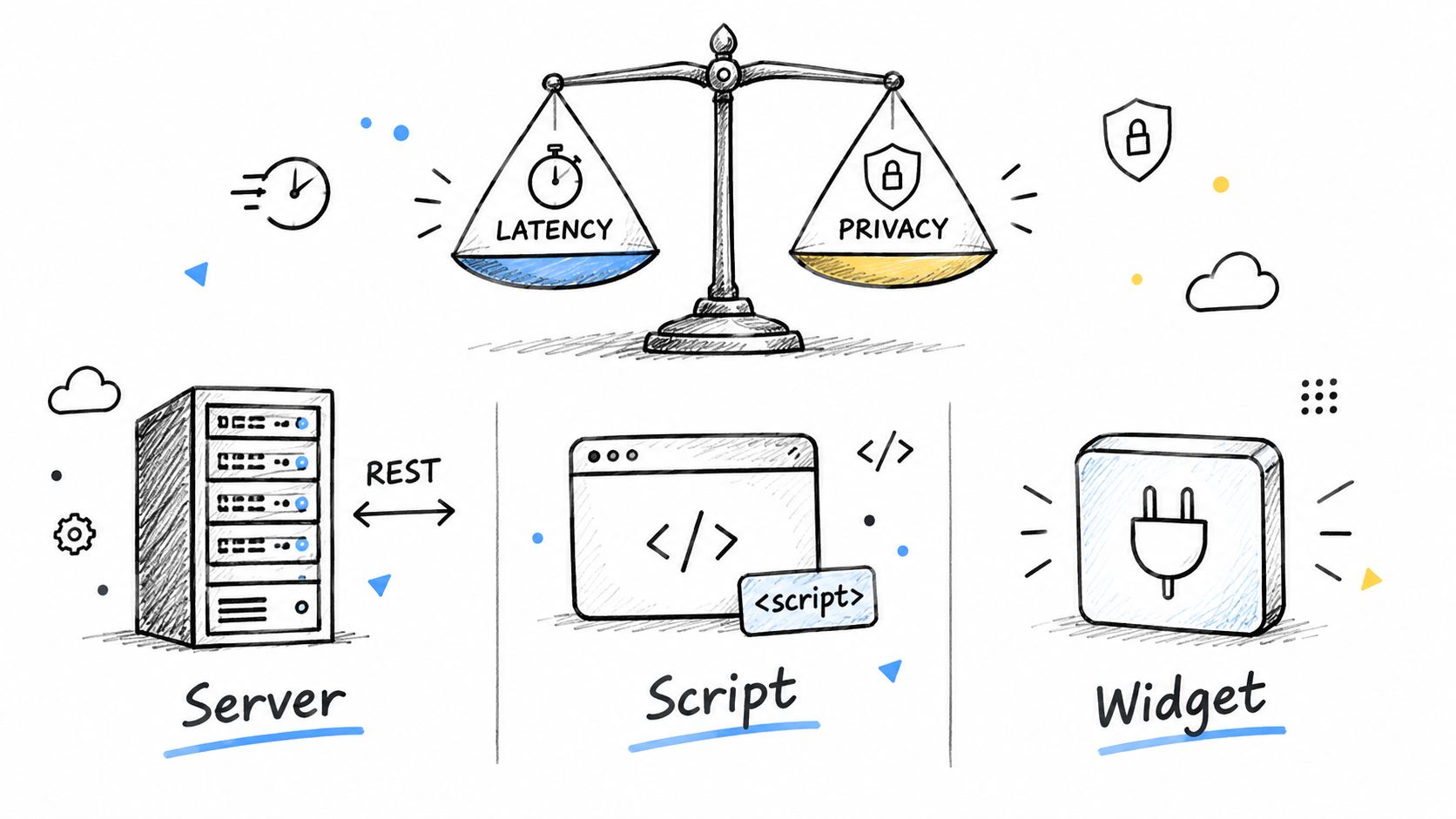
Three integration paths cover most production setups, and the right one depends less on preference than on where you can tolerate risk. Each moves latency, key exposure, and maintenance burden to a different place.
| Approach | Strength | Cost you accept |
|---|---|---|
| Server-side REST call | Key stays off the browser, full control over retries and logging | Extra network hop between browser, your backend, and the API |
| Client library via your proxy | Snappier perceived feedback, custom UI control | You maintain the proxy and handle cross-origin quirks |
| Drop-in widget | Fastest to ship, vendor maintains provider lists | Third-party script on your page, less control over behavior |
Calling the API directly from the browser with an embedded key isn't on that list for a reason. Anyone who views your page source owns your quota. If a client library appeals to you, route it through a thin endpoint on your own server that holds the key and rate-limits by session.
Matching the Path to Your Team
Compliance-heavy teams should default to the backend call. You control what address data leaves your infrastructure, you can log verdicts alongside the account record, and your retry policy lives in one place your auditors can read. The extra hop is real, but debounce hides most of it from the user.
Lean teams launching in days have a different calculus. A managed widget shifts disposable-domain lists, role-account detection, and provider behavior updates to the vendor. CleanMyList, for example, offers a one-line signup widget alongside its synchronous API endpoint, so a team can start with the widget on marketing pages and move sensitive flows to server-side calls later without changing vendors.
Hybrid setups are common and sensible. Use the widget or client path where speed of shipping matters, keep transactional account creation on a backend call, and make sure both write the same verdict fields into your database. Mixed data models will hurt you more than mixed transports.
Why SMTP Acceptance Is Not Deliverability
The most persistent myth in validation is that a server accepting your recipient command proves the mailbox exists. It doesn't. As the analysis of whether SMTP verifies sender or recipient authenticity makes clear, a positive response only shows the receiving system accepted that command at that moment. It says nothing about whether a person owns the mailbox, reads it, or ever created it.
Where the Probe Misleads You
Catch-all domains are the clearest failure. The server accepts genuine and invented local parts with identical responses, so mailbox existence is unknowable at the SMTP layer for that domain. Any vendor returning a confident valid for a random string at a catch-all domain is inventing certainty.
Other defenses muddy the signal further:
- Greylisting: The server defers first contact on principle, so a probe gets a temporary refusal for a perfectly good address.
- Accepting gateways: A front server accepts everything and sorts it out later, deferring the answer past your probe.
- Verification suppression: Anti-abuse systems deliberately obscure mailbox enumeration, returning vague or uniform responses.
- Provider-level limits: Large receivers restrict probing behavior, so results skew inconclusive regardless of the address.
The Graded Verdict Model
Replace the binary gate with three outcomes and explicit reasons. Send means combined signals support mailing the address. Review means something inconclusive or risky showed up, such as catch-all behavior or a blocked probe. Skip means evidence supports exclusion, such as no mail route or a permanent rejection.
Different programs should treat review differently, and that's the point. A newsletter can accept review addresses and let engagement sort them. A transactional signup can accept them too, since blocking a real customer is worse than one bounced receipt. Cold outreach should be far stricter, because your reputation budget there is thin. Exposing the reason field lets each program apply its own policy, which connects directly to how you think about scoring overall email deliverability rather than any single check.
Validation is probabilistic risk scoring, not a truth test. The honest output is evidence plus confidence, and any tool promising certainty at the SMTP layer is overselling what the protocol reveals.
Judge a validator on measurable operational outcomes instead of a headline accuracy claim. Track false-positive and false-negative rates by provider on a labeled sample, watch timeout and catch-all rates, and compare verdicts against your actual post-send hard-bounce rate. Those numbers tell you whether the service earns its place in your signup flow.
Error Handling, Retries, and Privacy Basics
Production behavior is defined by what happens when things go wrong. Transient 4xx SMTP responses and DNS timeouts deserve retries with bounded exponential backoff, because the condition often clears. Permanent 5xx responses should not be retried indefinitely, since the server has already given you a final answer and hammering it helps nobody.
Add a circuit breaker around the whole integration. When the validation service degrades, short-circuit to unknown and let signups proceed, queuing addresses for later recheck. Blocking account creation because a validation vendor is down trades your core product's availability for a data-quality preference.
Privacy rules are equally concrete. Never send an actual verification email to the address under test, since that creates consent, privacy, and reputation risk before the user agreed to anything. Encrypt address data in transit and at rest, delete uploaded lists on a defined schedule, and document retention in line with GDPR email compliance obligations and CCPA expectations.
Validation also doesn't replace authentication on your sending side. Google's sender guidance requiring SPF or DKIM for all senders, and SPF, DKIM, and DMARC for bulk senders applies no matter how clean your list is. And as the overview of verification types across the lifecycle reinforces, one check at signup isn't permanent. Block obvious fakes synchronously, score ambiguous addresses without rejecting legitimate users, then re-run older lists before major campaigns as mailboxes go stale.
Put that lifecycle into practice with a validator that returns graded verdicts and plain-English reasons instead of a bare yes or no, starting at signup and continuing through bulk rechecks before you send. Visit CleanMyList to test the API and signup widget against your own form traffic, and see how many plausible-looking bad addresses your current checks are letting through.